
The FGS Casino Stack: Simulated “Instant Bank Transfer” Rails, PayOp, and Visa-Owned Tink

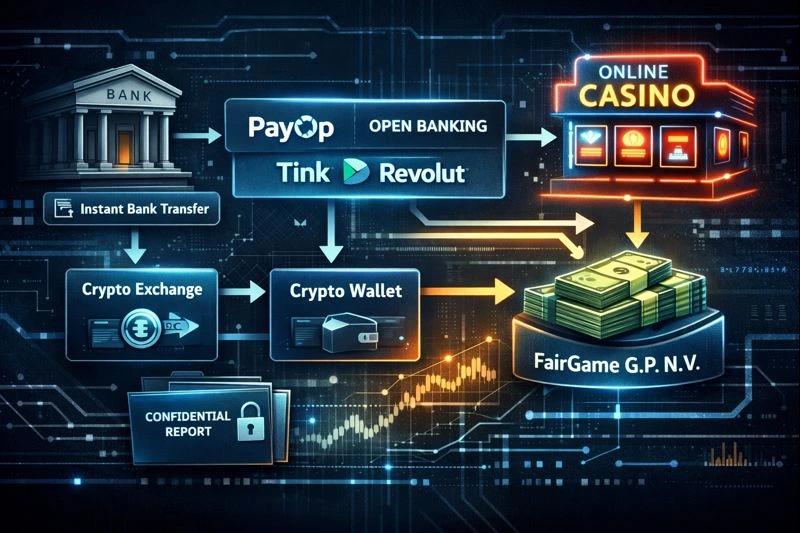
A Scam-Or Project Rail Atlas review of the FGS Software Solutions casino network — Monixbet, Rakoo Casino, and VoltSlot — reveals a standardized and repeatable deposit architecture. The observed setup combines three primary rails:
- so-called “instant bank transfer” options that operationally resemble a crypto on-ramp converting funds into USDC (via Rillpay → Kryptonim),
- an open-banking chain where PayOp routes players through Visa-owned Tink and onward to Revolut’s open-banking authorization interface, and
- alternative “instant banking” paths using Contiant and a misspelled gateway domain (paymentproccesing.net), alongside MiFinity deposits settling to FairGame G.P. N.V. as the payment recipient.
Key Findings (Observed and Corroborated)
- Uniform rails across brands: Monixbet, Rakoo Casino, and VoltSlot display nearly identical cashier configurations, including bank, crypto, and “instant” variants.
- Consistent payment recipient: Screenshots and flow wording show deposits directed to FairGame G.P. N.V. (Curaçao) in multiple rails, including MiFinity and PayOp/Tink paths.
- Open-banking chain identified: PayOp → Tink (link.tink.com) → Revolut OBA (oba.revolut.com) → settlement to FairGame G.P. N.V.
- Contiant embedded in the ecosystem: A misspelled gateway domain (paymentproccesing.net) appears in cashier flows; Similarweb signals show monixbet.com among referrers to paywith.contiant.com (small but present).
- PayOp’s iGaming positioning: PayOp publicly markets iGaming payment services and identifies its operating entity in its documentation.
- Tink ownership: Tink is a Visa-owned open-banking provider following Visa’s acquisition, promoting payment-initiation use cases, including for iGaming.
Rail Map Snapshot: How Funds Move
1) “Instant Bank Transfer” Functioning as a Crypto On-Ramp
- Player selection: “Direct Bank Transfer / Instant Bank Transfer” (casino cashier label)
- Observed stack: Rillpay → Kryptonim → USDC → casino wallet(s)
- Why it matters: This pattern mirrors offshore casino setups where a bank-style UI masks a crypto purchase. It reduces traditional card/acquirer visibility and shifts AML/KYC weight to the crypto leg.
Kryptonim context: Kryptonim publicly references a VASP licence entry number and multiple registered entities.
2) Open-Banking Rail: PayOp → Tink → Revolut OBA → FairGame G.P. N.V.
- Player selection: PayOp
- Observed flow:
- PayOp routes the user to Tink (link.tink.com), explicitly stating that FairGame G.P. N.V. uses Tink to process the payment.
- The user is redirected to Revolut’s open-banking authorization page (oba.revolut.com) with “Authorize Tink AB.”
- Interpretation: This aligns with a PIS/AIS account-to-account payment flow, where Tink provides the open-banking layer and Revolut handles bank-side consent.
Tink context: Following Visa’s acquisition, Tink markets open-banking payment initiation, including iGaming-related scenarios.
PayOp context: PayOp’s materials position it in high-risk/iGaming processing and disclose its operator entity in its terms.
3) Contiant Rail via Misspelled Gateway
Monixbet → paymentproccesing.net → (Contiant / Bank Selection / Revolut OBA)
- Player selection: “Instant Bank Transfers”
- Observed indicators:
- Browser activity shows requests to paymentproccesing.net (double “cc”), indicating an intermediary deposit gateway.
- Similarweb data links monixbet.com as a referrer to paywith.contiant.com, connecting this casino to the same Contiant ecosystem previously mapped.
- Contiant context: Merchant documentation describes Contiant as a Bulgarian entity providing technical AIS/PIS services, often layered in front of regulated open-banking rails, with notable Benelux exposure.
4) MiFinity Rail
Monixbet → paymentproccesing.net → MiFinity → FairGame G.P. N.V.
- Observed:
- A MiFinity-branded deposit page hosted on paymentproccesing.net displays “Deposit to FairGame G.P. N.V.” and MiFinity support contact details.
- MiFinity context: MiFinity states it holds dual licences (UK FCA and Malta MFSA). Its legal terms identify MiFinity UK Limited as an FCA-authorised EMI (Register Ref. 900090).
Who Acts as the Payment Agent?
Testing indicates FairGame G.P. N.V. (Curaçao) appears as the named recipient or payment agent across several rails, including PayOp/Tink wording and MiFinity deposit pages. This suggests consolidation of player funds at a central entity positioned between casino brands and upstream PSP or open-banking providers.
Verification targets include:
- Bank beneficiary details (IBAN/BIC)
- Merchant IDs and settlement statements
- PayOp/Tink client_id mappings
- Descriptors showing where and how funds ultimately settle
Why This Matters: A Compliance Perspective
Benelux Exposure and Open-Banking Chokepoints
Earlier Contiant traffic intelligence pointed to strong Netherlands/Belgium banking links. Using these rails to fund offshore casinos potentially targeting NL/BE consumers without local authorisation creates a high-risk corridor for banks and regulators.
Open-Banking as a “Quiet Rail”
Even when the open-banking layer is regulated (e.g., Tink as a payment institution, MiFinity as an EMI), risk accumulates at onboarding and monitoring points: merchant-of-record identification, downstream brand networks, and affiliate funnels.
Gateway Opacity as a Red Flag
Thin or oddly named cashier domains such as paymentproccesing.net obscure consumer recognition, complicate dispute handling, and hinder third-party monitoring. They also raise questions about control of the payment page and embedded scripts or vendors.
Call for Information (Scam-Or Project Whistleblower Section)
If you possess direct evidence related to these rails — including PayOp/Tink onboarding records, merchant contracts, settlement statements, merchant-of-record documentation, bank beneficiary details, ownership of paymentproccesing.net, or correspondence with compliance teams — please submit it via the Scam-Or Project whistleblower section.
We are specifically seeking:
- PayOp account and merchant IDs
- Tink client_id mappings and service agreements
- Bank transfer descriptors and beneficiary IBANs
- Proof of control over cashier gateway domains
- Regulator notices, dispute or chargeback logs, and account closures linked to these flows