
THE MEXC SHADOW RAIL

Finetix, Paytend Europe, and the Romanian–Lithuanian Obfuscation Structure
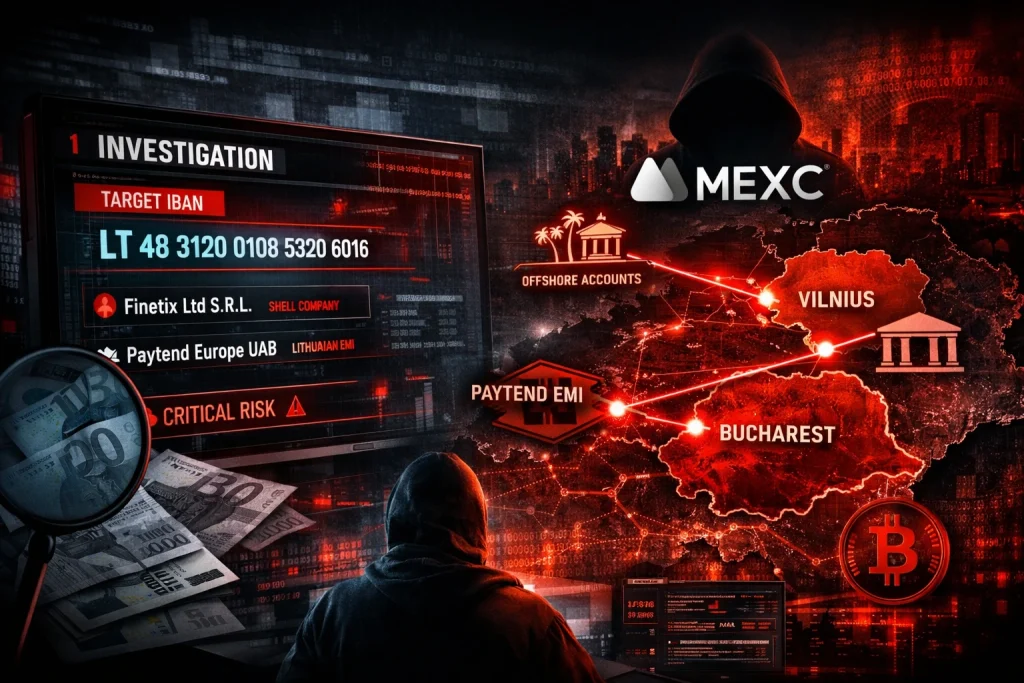
A recent forensic investigation has exposed the covert payment infrastructure enabling Euro-denominated deposits into the globally blacklisted exchange MEXC. Through a deliberately layered structure spanning Romania and Lithuania, MEXC appears to circumvent regulatory oversight and banking controls. At the center of this structure is what investigators describe as a “ghost” merchant configuration — a payment setup designed to conceal the true beneficiary of funds within the European financial system.
The Architecture of Concealment
Despite repeated regulatory warnings across Europe concerning MEXC Global, the exchange continues to process substantial Euro inflows via its domains MEXC.com and the mirrored MEXC.co.
One of the core deposit rails facilitating this flow operates through:
- Finetix Ltd S.R.L. (Finetix Limited S.R.L.), Romania
- Paytend Europe UAB, Lithuania
By inserting a Romanian commercial entity as the visible payee and routing funds through a Lithuanian Electronic Money Institution (EMI), the system effectively obscures the connection between the depositor and MEXC. As a result, automated compliance systems within banks may fail to detect that the funds are ultimately intended for a crypto exchange facing regulatory scrutiny.
Forensic Compliance & Risk Review
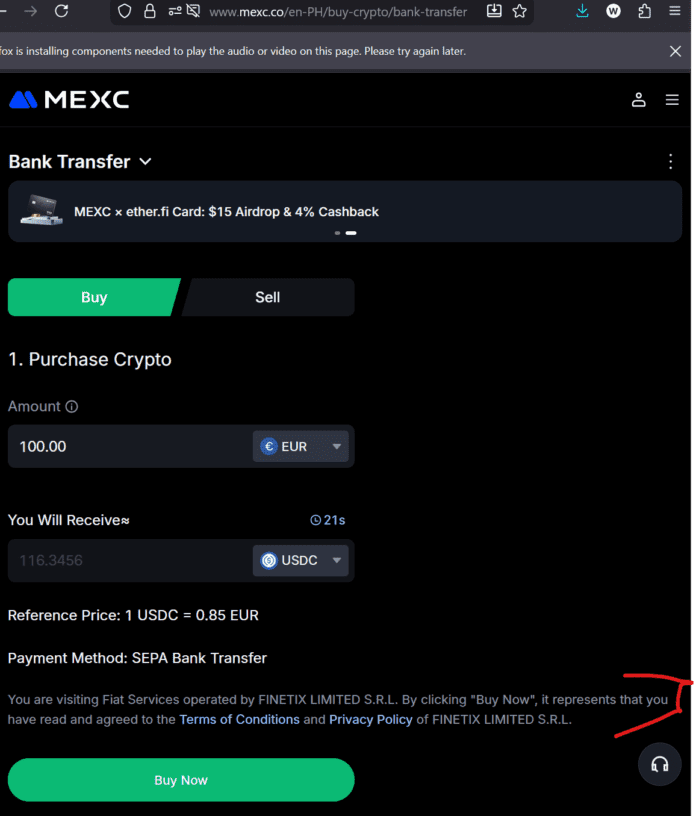
1. The “Ghost” Payee — Finetix Limited S.R.L.
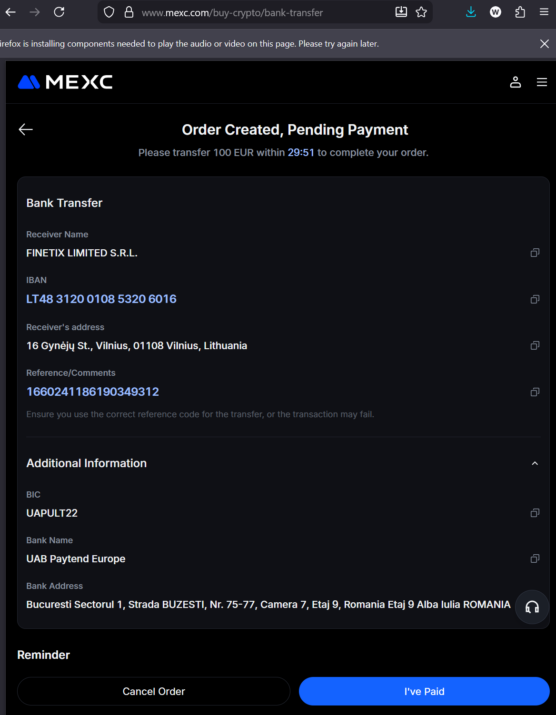
When an MEXC user initiates a Euro bank transfer, the beneficiary is not MEXC. Instead, users are instructed to send funds to:
Finetix Ltd S.R.L. / Finetix Limited S.R.L.
Strada BUZESTI, Nr. 75-77
Bucharest, Romania
This Romanian company is not registered or regulated as a crypto service provider. It holds no financial services or digital asset licenses. Structurally, it is a standard limited liability company.
Its function appears to be that of “Merchant of Record,” ensuring that the name “MEXC” does not appear on a customer’s bank statement.
Observational indicators suggest a close operational relationship between Finetix and MEXC:
- Overlapping wording and interface elements between platforms
- Mirrored transaction logic and user flows
- The official Finetix website (www.finetix.net) is non-functional
- Registration and transaction execution are not possible
- The website publicly advertises crypto purchases but does not allow operational onboarding
These characteristics strongly indicate that the Finetix site functions primarily as a facade connected to the MEXC infrastructure.
2. The Financial Conduit — Paytend Europe UAB
The Euro deposits are directed to the following Lithuanian IBAN:
IBAN: LT48 3120 0108 5320 6016
Institution: Paytend Europe UAB
Location: Vilnius, Lithuania
Paytend Europe UAB is a licensed Electronic Money Institution (EMI) in Lithuania and provides virtual IBAN (vIBAN) services.
However, payment instructions associated with this IBAN list the Romanian address of Finetix (Strada BUZESTI, Nr. 75-77) as the “Bank Address.” This practice is irregular and potentially designed to disrupt automated AML systems that check for consistency between beneficiary location and banking jurisdiction.
Notably, Paytend Europe UAB is not a crypto exchange. It functions as a regulated financial intermediary providing payment infrastructure — effectively acting as a conduit within this arrangement.
The Triple-Masking Strategy
The forensic examination of IBAN LT483120010853206016 reveals a deliberate multi-layer masking mechanism:
1. Address Misdirection
The Romanian address is listed as the “Bank Address” despite the IBAN being Lithuanian. This creates jurisdictional ambiguity that can impair automated AML flagging mechanisms.
(Note: Strada BUZESTI, Nr. 75-77 is a high-density virtual office location frequently used by fintech and IT firms.)
2. Romanian Commercial Shell
Finetix Limited S.R.L. is a standard Bucharest-registered entity with no crypto or financial services authorization. It operates as a contractual shield between users and MEXC.
3. Lithuanian EMI Layer
Funds are received through Paytend Europe UAB’s Lithuanian IBAN infrastructure. While licensed as an EMI, Paytend does not operate as a crypto exchange. Its infrastructure is being used as a financial passthrough.
Compliance & Structural Risk Assessment
Verdict: CRITICAL RISK (BLACK)
There is no registered Virtual Asset Service Provider (VASP) in the transaction chain.
Funds are transferred to an unlicensed Romanian commercial entity and are then presumed to be routed toward offshore MEXC liquidity pools.
Transaction Chain Overview
| Component | Entity | Function | Status |
|---|---|---|---|
| Brand | MEXC | Public-facing exchange | High Risk |
| Contractual Payee | Finetix Limited S.R.L. | Romanian Merchant of Record | Unlicensed |
| Financial Rail | Paytend Europe UAB | Lithuanian EMI (vIBAN provider) | Intermediary |
| Crypto License | NONE | No VASP authorization | Critical Failure |
The Structural Exposure
Registered MEXC users may believe they are utilizing a secure EU bank transfer mechanism. In reality, they are engaging in an unregulated shadow settlement structure with:
- No consumer safeguards
- No deposit insurance
- No MiCA compliance anchor
- No licensed VASP entity within the chain
Under the MiCA 2026 framework, payment arrangements structured to bypass crypto authorization requirements are subject to regulatory enforcement and substantial penalties.
The decoupling of:
- Brand (MEXC)
- Contractual Payee (Finetix Limited S.R.L.)
- Financial Infrastructure (Paytend Europe UAB)
constitutes a classic transaction-masking configuration.
Whistleblower Request
Scam-Or Project invites insiders with direct knowledge of:
- Finetix Limited S.R.L.
- MEXC operational structures
- Paytend Europe UAB compliance processes
to submit information via the Scam-Or Project whistleblower section.
Key questions requiring clarification:
- What is the actual transaction volume flowing through IBAN LT483120010853206016 under the designation “Digital Asset Purchase”?
- Who is the Ultimate Beneficial Owner (UBO) of Finetix Limited S.R.L.?
- What compliance assessments were conducted regarding this payment structure?
Documentary evidence from internal compliance officers or operational staff may provide critical transparency into this Romanian–Lithuanian shadow rail network.