
VASP “Payment Template” Exposed: DAXCHAIN and ChainValley as Fiat Collection Nodes for Offshore Casino Deposits

How Offshore Casinos Use VASP Payees to Stay Out of the Payment Line-of-Fire
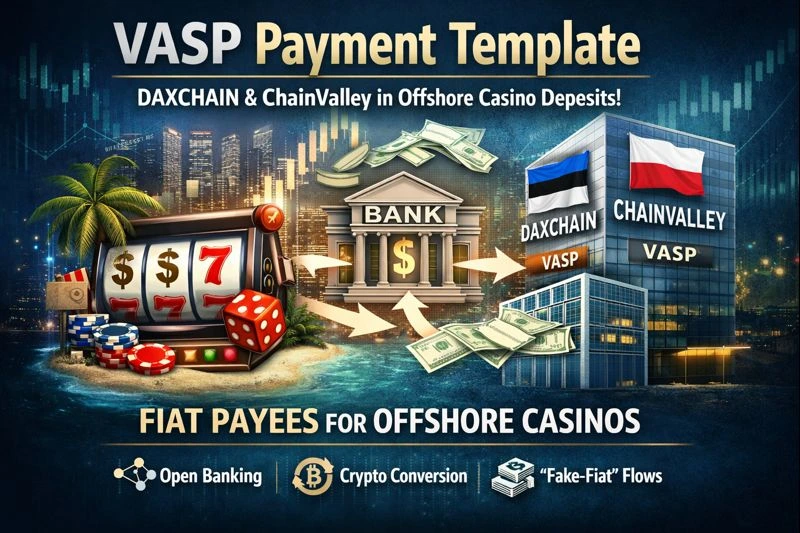
Recent Scam-Or Project Rail Atlas reviews of Stellar-linked offshore casinos reveal a highly repeatable payment architecture. Instead of routing player funds directly to a gambling operator, deposits are consistently redirected through VASP-registered intermediaries, most notably DAXCHAIN (Estonia) and ChainValley (Poland). These entities appear to operate as fiat collection endpoints, effectively shielding the casino from direct exposure to payment enforcement.
This is not an isolated anomaly. The structure resembles a scalable, industrialized model designed to decouple the casino from the actual payment event while preserving the appearance of legitimate funding rails.
Key Observations
- Multiple casino brands associated with Stellar display near-identical UX flows and payment logic, consistent with Scam-Or Project’s earlier Stellar / Legiano investigations.
- Italian regulators have blocked several related domains, including AllySpin and Supabet variants, yet operators continuously rotate through domain “mutations,” weakening DNS-level enforcement.
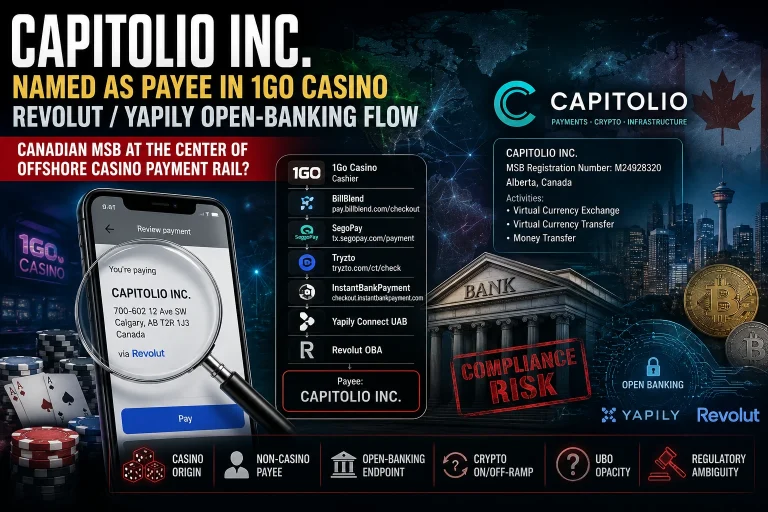
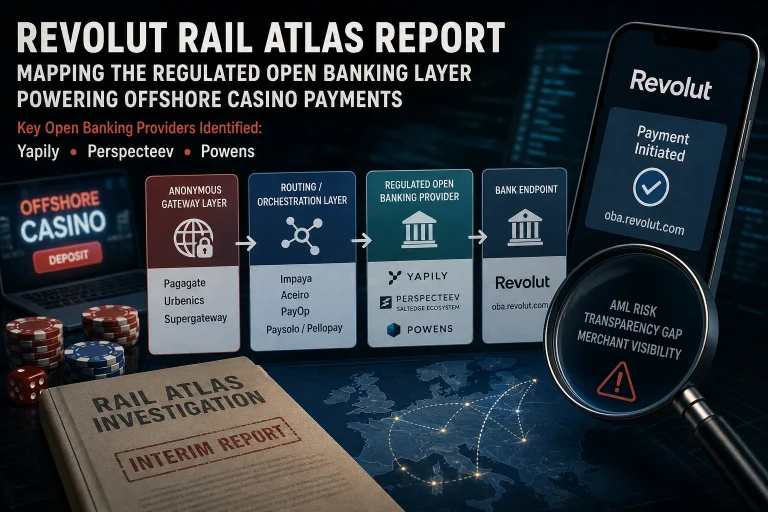
- Open-banking journeys funnel users through layered gateway paths that ultimately list DAXCHAIN OÜ (www.daxchain.eu) as the payee—despite its public positioning as a virtual-currency service provider rather than a licensed payment institution.
- Estonian register data identifies Olegs Bogdanovics as a beneficial owner of DAXCHAIN. The company holds a virtual-currency authorization, raising a critical question: why is a VASP receiving bank transfers for offshore casino deposits?
- ChainValley continues to surface as a recurring node. Scam-Or Project previously documented “fake-fiat” deposits in which Skrill or Neteller funding is converted into USDC / USDC.e and forwarded to casino wallets—while presented to users as a standard casino deposit.
Short Narrative: Industrialized Deposit Rails
Our latest reviews of WinBay, AllySpin, LuckyMax, Spinbara, and Supabet reinforce conclusions already drawn from the Legiano/Stellar cases: offshore casino groups are standardizing payment rails just as aggressively as they standardize domain churn.
The critical issue is not merely the availability of open banking. It is who receives the funds. Rather than a clearly identified, licensed gambling operator, the payment trail terminates at intermediaries such as DAXCHAIN (Estonia) and ChainValley (Poland). From a compliance standpoint, this is a structural red flag. The merchant-of-record layer appears intentionally engineered to keep the casino one step removed from the transaction.
Extended Analysis
The Core Regulatory Issue Is Not Open Banking — It Is Payee Engineering
1. PSD2 Obligations Do Not Vanish Behind “Crypto” or “Open Banking” Labels
Under PSD2 (Directive (EU) 2015/2366), payment services within the EU are regulated activities subject to authorization or registration with national competent authorities and inclusion in EU-level registers.
When an entity effectively acts as a fiat collection agent—receiving consumer bank transfers that finance offshore gambling—the following questions naturally arise:
- Is the entity authorized or registered as a payment institution or e-money institution for this activity?
- If not, how is the transaction legally characterized from the consumer’s perspective?
This is precisely where “fake-fiat” architecture becomes useful for operators. By internally framing the transaction as a crypto purchase, even when the user interface presents it as a casino deposit, intermediaries attempt to migrate from the PSD2 payment-agent framework into the VASP perimeter.
2. DAXCHAIN: Virtual-Currency Authorization, Fiat Payee Reality
Public records indicate that DAXCHAIN holds an Estonian FIU authorization for virtual-currency services, referenced in FIU communications under license number FVT000045. Separately, Estonia’s business register discloses ownership and control information, including the listed beneficial owner.
However, none of this resolves the core PSD2 concern:
Why is a VASP named as the recipient in a bank-transfer flow that ultimately funds offshore gambling activity?
If the underlying commercial purpose is gambling, routing fiat payments through a VASP looks less like innovation and more like regulatory perimeter-hopping.
3. ChainValley: A Repeatable “Fake-Fiat” Conversion Hub
ChainValley appears in Poland’s virtual-currency activity register. Polish authorities have explicitly stated that inclusion in this register does not equate to a PSD2 financial services license or supervisory approval.
Earlier Scam-Or Project reporting on Legiano/Stellar illustrated the mechanics of these flows:
- User selects “deposit”
- Embedded crypto purchase (USDC / USDC.e)
- Automatic transfer to a casino wallet
- Funding via Skrill or Neteller rails
The consumer technically receives the crypto asset, which significantly weakens dispute and chargeback rights—even though the user’s clear intent was to fund a casino account.
In the current Stellar-linked set, ChainValley reappears, now combined with familiar consumer payment brands (Skrill, Neteller, PaysafeCard) and the Lithuanian UTRG d/b/a utPay—entities never designed to operate as silent feeders for offshore casino stablecoin pipelines.
4. The Visa / Tink Question: When Open Banking Becomes a Gambling Rail
Our analysis identified payment cascades that include Tink within the open-banking confirmation path. Visa has publicly confirmed its acquisition of Tink and positions it as an API-driven platform for payment initiation and data access.
This raises unavoidable compliance questions:
- If regulated open-banking infrastructure initiates payments to VASP payees that are repeatedly linked to unlicensed offshore casinos, what merchant and category screening is actually applied?
- Are these transactions classified as “crypto purchases” to permit processing, despite a downstream gambling purpose?
- If so, does this represent a control failure—or a deliberate business model?
Actionable Compliance Questions That Demand Answers
-
For DAXCHAIN and ChainValley:
What is the precise contractual product—casino deposit facilitation or crypto on-ramp? If framed as a crypto purchase, why does the UX present it as casino funding? -
For open-banking intermediaries (including Tink stack participants):
What enhanced due diligence is triggered when a VASP payee repeatedly appears in offshore gambling deposit flows? -
For e-wallet rails (MiFinity-style patterns):
Why do payees such as CANAMONEY EXCHANGE LTD and CenturaPay consistently re-emerge in casino cashier flows? What merchant monitoring controls are preventing repeat exposure? -
For regulators and FIUs:
Are VASP registrations being used as a de facto backdoor to operate payment-agent services for high-risk sectors such as illegal gambling and shadow trading? If so, where is the enforcement boundary?
Call for Information
If you have access to internal documentation, merchant onboarding files, payee descriptors, settlement account data, wallet clustering evidence, or materials clarifying how DAXCHAIN and ChainValley classify these transactions (casino funding versus crypto purchase), we invite you to share them securely via the Scam-Or Project whistleblower section.
We are particularly interested in:
- Merchant-of-record identities
- Transaction narratives used for bank compliance
- Chargeback and complaint outcomes
- Gateway-switching logic between payment endpoints
- Correspondence with regulators