
Green Finance 2025: Barclays’ Landmark Carbon Removal Deal with UNDO

Executive Summary
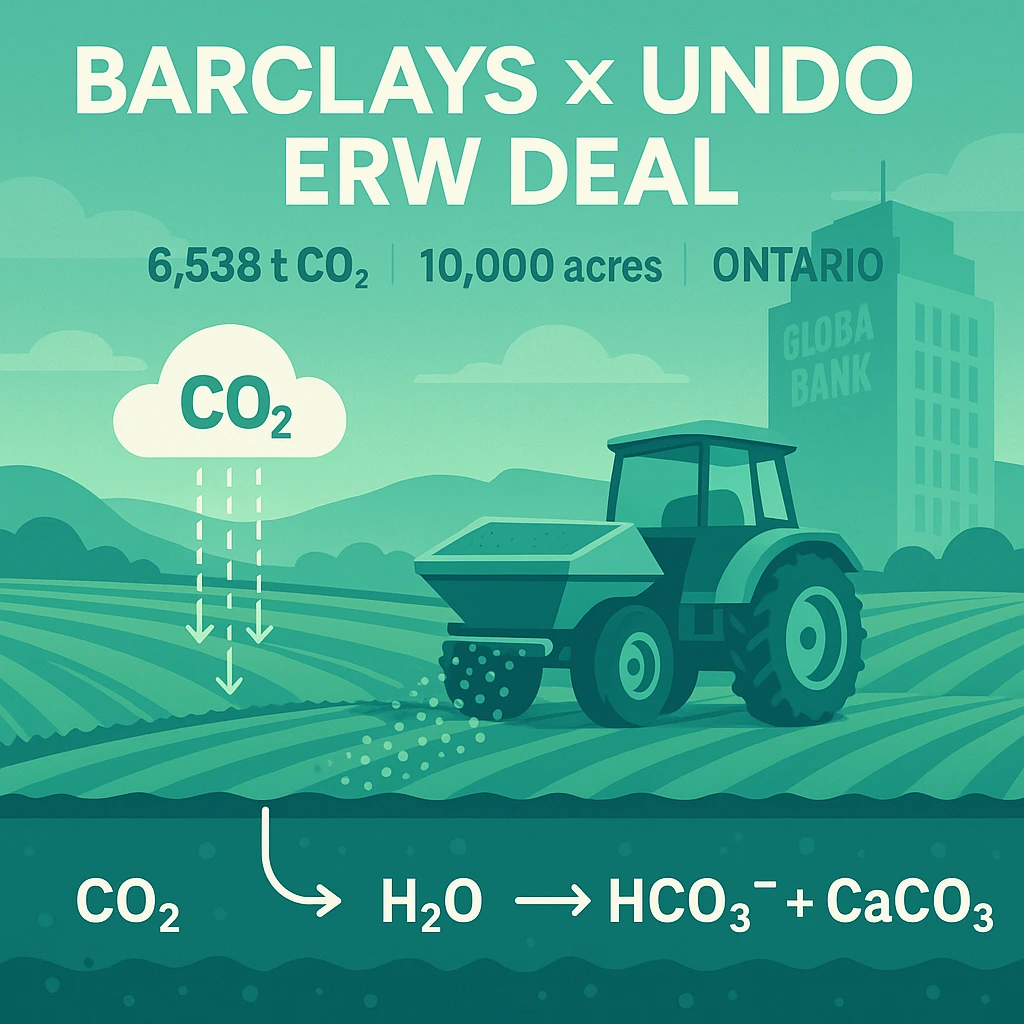
Barclays Bank has signed its first large-scale carbon dioxide removal (CDR) agreement with UNDO (website), a climate-tech firm specializing in enhanced rock weathering (ERW). Under this UK-led contract, UNDO will permanently remove 6,538 tonnes of CO₂ by applying finely crushed silicate rocks across 10,000 acres of farmland in Ontario, Canada—the largest ERW engagement to date for a British supplier.
Partnership Overview
-
Parties: Barclays Bank ↔ UNDO (XPRIZE winner)
-
Mechanism: Enhanced rock weathering (application of silicate minerals on agricultural land)
-
Location: Ontario, Canada (10,000 acres)
-
Impact: 6,538 tonnes of CO₂ durably removed
-
Structure: Innovative pre-financing model aligned with Barclays’ multi-year net-zero roadmap
Why It Matters for Barclays
Barclays reports a 95% reduction in Scope 1 and 2 emissions and is now complementing internal decarbonization with high-integrity, permanent CDR to address residual emissions within a broader transition plan.
How UNDO’s ERW Works (In Brief)
-
Rock Selection & Milling: Silicate rocks are crushed to increase surface area.
-
Field Application: Material is spread over cropland using standard farm equipment.
-
Chemical Weathering: Natural reactions draw down atmospheric CO₂, forming stable bicarbonates/carbonates.
-
Durable Storage: Carbon is locked away on geological timescales, with MRV (measurement, reporting, verification) to quantify removal.
Co-Benefits for Agriculture
-
Soil Health: Mineral additions can improve soil chemistry and structure.
-
Crop Productivity: Potential yield improvements tied to nutrient release.
-
Community Support: Revenue and resilience benefits for participating farm operators.
Market Context: Green Investment Trends in 2025
-
The green economy is valued at $7.9 trillion, roughly 8.6% of listed equities (Q1 2025).
-
Institutional demand for durable CDR is rising, driven by long-term net-zero commitments and evolving regulation.
-
Cumulative climate-action investment could reach up to $275 trillion by 2050, channeling capital to clean tech, nature-based solutions, and innovative financing.
Sector Implications
-
Normalization of Permanent CDR: Deals like Barclays-UNDO push CDR from pilot to portfolio component.
-
Banking’s Expanded Role: Financial institutions are shaping carbon markets via structured offtakes and pre-financing.
-
Technology Scale-Up: Bank-backed offtakes de-risk deployment, accelerate learning curves, and enhance MRV rigor.
-
Corporate Residuals Strategy: High-integrity removals help close the gap after primary emissions cuts.
Key Facts (At a Glance)
| Item | Detail |
|---|---|
|
Buyer |
Barclays Bank |
|
Supplier |
UNDO (website) |
|
Method |
Enhanced Rock Weathering (ERW) |
|
Location |
Ontario, Canada |
|
Acreage |
10,000 acres |
|
CO₂ Removal |
6,538 tonnes (permanent) |
|
Barclays Progress |
Scope 1 & 2 emissions reduced by 95% |
|
Contract Feature |
Pre-financing structure |
|
Market Backdrop |
Green economy ~$7.9T (8.6% of equities), Q1 2025 |
|
Long-Term CapEx |
Climate investments up to $275T by 2050 |
Conclusion
The Barclays–UNDO agreement marks a pivotal step in integrating permanent CDR into mainstream finance. By combining innovative financing with science-backed ERW, the deal advances corporate decarbonization, strengthens agricultural co-benefits, and signals growing institutional confidence in durable carbon removal pathways.
Share Information
Have relevant documents, data points, or on-the-ground insights about ERW projects, CDR procurement, or related financing structures? Share information to support due-diligence and market transparency.