
Citi: Hyperscalers Could Invest $2.8 Trillion in AI Infrastructure by 2029

Executive Summary
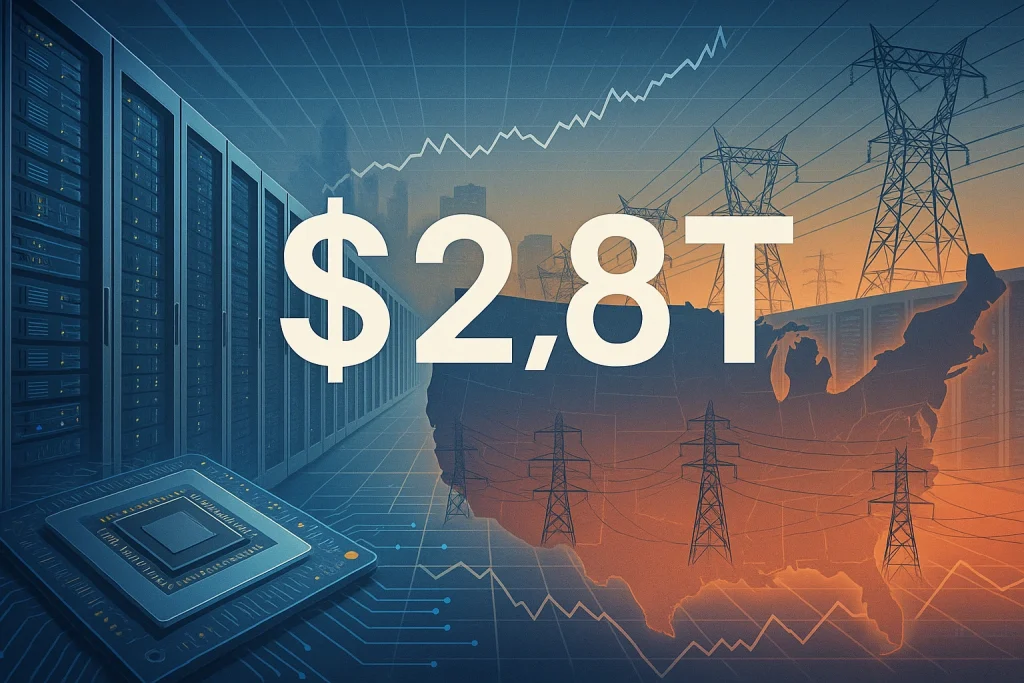
Citi has increased its outlook for AI-related capital expenditures by the largest U.S. hyperscalers—Amazon, Alphabet (Google), Microsoft, and Meta—projecting up to $2.8 trillion through 2029. The build-out is front-loaded, with roughly $490 billion expected by end-2026, and is constrained primarily by the availability of power. Citi estimates the ecosystem will need about 55 GW of additional capacity by 2030, a requirement likely to push companies toward greater use of debt and weigh on free cash flow in the near term. (Source: Reuters)
Forecast at a Glance
-
Total AI capex (2024–2029): >$2.8T (previous estimate $2.3T).
-
Near-term cadence: ~$490B by end-2026.
-
Power bottleneck: ~55 GW incremental capacity by 2030 (~$50B per GW).
-
Geography: ~$1.4T of spend in the United States.
-
Funding mix: Shift from internally funded capex toward debt financing, pressuring FCF.
Why the Forecast Was Lifted
Citi’s higher number reflects a broadening and deepening of spend across:
-
Compute (GPUs/accelerators and associated silicon)
-
Data centers (new builds, expansions, land)
-
Networking (optics, switching, interconnects)
-
Thermal/cooling (advanced liquid/immersion systems)
-
Power (grid interconnects, PPAs, on-site generation, storage)
The Power Constraint (and What It Implies)
| Metric | Citi View / Context |
|---|---|
|
Additional capacity needed |
~55 GW by 2030 |
|
Cost proxy |
≈ $50B per GW (rule-of-thumb) |
|
Primary risks |
Grid upgrades, permitting, interconnect queues, PPA availability |
|
Likely responses |
Build-ahead-of-demand, on-/near-site generation, long-dated PPAs, load shifting |
This is utility-scale demand. Timelines for transmission upgrades and interconnect approvals could become the pacing item for AI capacity.
Investment Takeaways
Potential beneficiaries
-
AI compute & accelerators: GPU/ASIC vendors and their supply chains
-
Power & thermal: switchgear, transformers, chillers, liquid cooling
-
Utilities & IPPs: generation, transmission, long-term PPAs
-
Data center REITs/operators: land, power-dense facilities, interconnect hubs
Potential laggards/risks
-
Firms unable to secure power or finance the capex curve
-
Projects stuck in permitting or interconnect backlogs
-
Businesses with FCF sensitivity as debt share rises
What to Watch in Upcoming Earnings
-
Language around “build-ahead-of-demand”
-
Disclosure on PPAs, on-site generation, and grid interconnect queues
-
Updated capex guides and financing mix (debt vs. operating cash flow)
-
Commentary on regional allocations, especially the ~$1.4T expected in the U.S.
Short Analysis
Citi’s step-up signals an AI infrastructure super-cycle where power access and energy strategy become part of the moat, alongside compute and data. Near-term FCF compression from debt-funded capex may coexist with durable pricing power in AI cloud, training, and inference services as capacity is commissioned.
Call for Information
Are you working on hyperscaler power procurement, grid connections, PPAs, or data-center buildouts? We invite you to share insights or documents confidentially.