
Restoring Trust in European Payments: A Data-Driven Policy Blueprint

Executive Summary
A recent academic study argues that Europe’s progress on instant, low-cost payment rails has outpaced consumer protection against cyber-enabled fraud. Using a dataset of 1,750 victim cases across 20 countries with reported losses of €62.5 million, the study finds that deception-induced “authorised” push payments are rarely reimbursed and that clearly unauthorised transactions are handled inconsistently across Member States. The authors describe a dual protection gap that undermines user trust and enables abuse within parts of the payment stack.
Europe’s Payment Paradox
-
Modern rails, lagging safeguards. SEPA Instant and the 2024 Instant Payments Regulation accelerated transfers, while redress mechanisms and liability allocation have not kept pace.
-
APP fraud externalities. In authorised push-payment (APP) scams, losses frequently remain with consumers and remediation is fragmented and slow.
Evidence From the Dataset
-
Typologies. Numerous “pig-butchering” and investment-style scams route funds via “authorised” bank transfers or CNP card payments.
-
Victim outcomes. Respondents report denial, delay, or blame when seeking refunds; 39% reportedly terminated long-standing banking relationships following their experience.
-
Monetisation layer patterns. A recurring subset of PSPs, acquirers/EMIs, and beneficiary banks appear in cash-out flows, including cases of high-risk onboarding, MCC mis-coding, and mule activity. The study emphasises these patterns are contingent, not inevitable, supporting a shift in default liability toward actors best placed to prevent abuse.
Illustrative Case References
| Entity | Described Role | Noted Detail |
|---|---|---|
|
Payvision (ING) |
Processing of high-risk “investment” flows, incl. networks associated with Gal Barak / Uwe Lenhoff |
Internal figures cited in the study attribute ~€154m CNP volume to the “Wolf of Sofia” group |
|
Wirecard |
Pre-collapse operations cited as enabling illicit flows through acquiring units/subsidiaries |
Used as an example of risk normalisation at scale |
|
Københavns Andelskasse (DK) |
Pass-through hub for proceeds |
Subsequently fined DKK 794m for AML failures |
Note: These references are presented as described in the study; they are included to illustrate observed patterns rather than to assert legal conclusions.
Alternative Dispute Resolution (ADR)
-
Limited effectiveness. The paper reports that FIN-NET and national ombuds schemes are uneven in scope and often non-binding.
-
Reported result. In the surveyed cohort, ADR did not deliver meaningful relief.
Proposed Policy Direction
-
Outcome-based reimbursement. Treat consent obtained through deception as no consent, triggering refund obligations for fraud-induced payments.
-
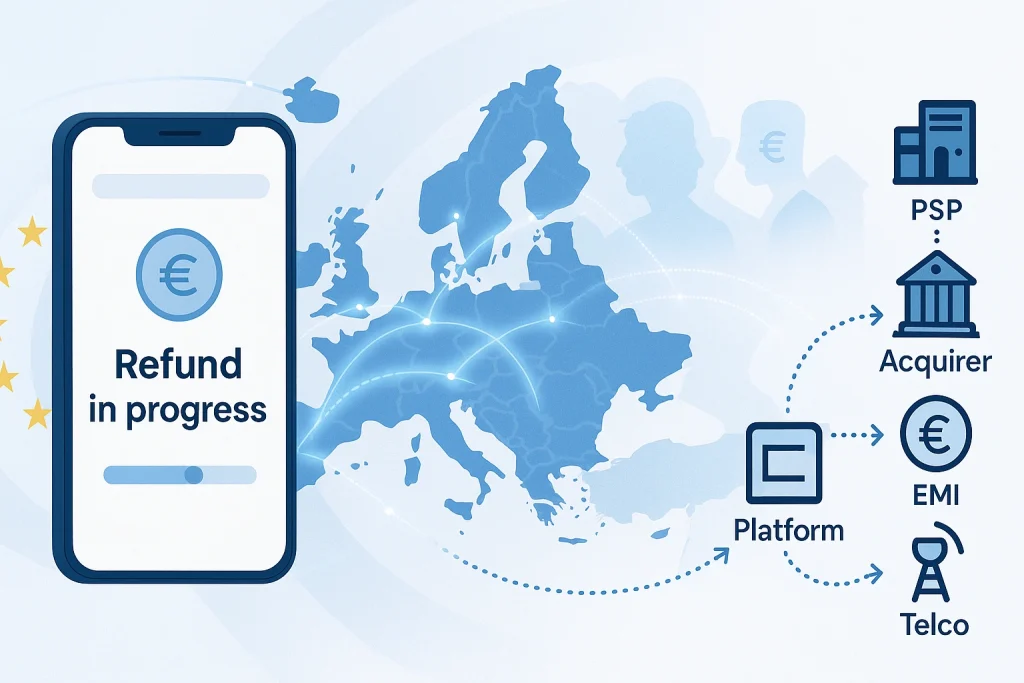
Reimbursement anchor at the payer’s ASPSP. The consumer’s bank reimburses first, followed by calibrated down-chain recourse (beneficiary PSPs, acquirers, platforms, telcos).
-
Redefine “consent.” Reclassify fraud-induced authorisations as unauthorised in law to align with immediate refund rules.
-
Binding, time-boxed ADR at EU level (FIN-NET 2.0). Establish deadlines, evidentiary presumptions, and disclosure duties.
-
EU Fraud Data Framework. Improve cross-institutional visibility on mule networks, layering patterns, and MCC camouflage.
-
Technology obligations. Mandate name/IBAN checks (CoP/VoP), real-time analytics, kill-switches, and structured cross-sector intelligence sharing.
Legislative Context: PSR Article 59
-
European Parliament (2024): Considered broader coverage and shared, cross-sector liability models spanning PSPs, ECSPs, and platforms.
-
Council “General Approach” (18 June 2025): Narrowed the main trigger to cases where a fraudster impersonates the consumer’s PSP (“bank spoofing”), with a 15-business-day refund deadline.
-
Implication. Many induced-consent scenarios (e.g., tax, police, brand or marketplace impersonation) remain out of scope; platforms/telcos largely unaffected.
-
Study’s assessment. A broader reimbursement model better aligns incentives across the chain and supports trust restoration; a narrow approach risks entrenching consumer-harmful outcomes.
Relevance to Illegal Casinos and Crypto
-
Dependence on regulated on/off-ramps. Illegal online casinos and unlicensed crypto venues rely on acquirers, PSPs, EMIs, beneficiary banks, and exchanges to collect, layer, and cash-out at scale. Weak onboarding/monitoring can facilitate these flows.
-
Controls and incentives. Stronger KYCC/EDD, MCC governance, inbound risk-scoring, mule controls, and beneficiary-side holds/recalls are recommended—paired with default liability so least-cost avoiders invest in prevention.
-
Bridging to fiat. Crypto-themed scams frequently monetise via EMIs/banks. Without outcome-based reimbursement and binding ADR, consumer losses persist while intermediaries capture fees.
Policy Checklist
-
Reclassify fraud-induced “authorisations” as unauthorised → immediate refunds.
-
Anchor liability at payer’s ASPSP with structured recourse to beneficiary-side actors.
-
Implement binding EU-level, time-boxed ADR (FIN-NET 2.0).
-
Mandate CoP/VoP, real-time analytics, and cross-sector information sharing.
-
Launch an EU Fraud Data Framework to expose mule networks and MCC camouflage.
Conclusion
The study concludes that Europe’s payment modernisation should be matched by outcome-based consumer protection and aligned liability. By redefining consent, anchoring reimbursement at the payer’s ASPSP, and establishing coordinated duties and data sharing, policymakers can reduce fraud externalities and strengthen public confidence in European payments.
![[WHISTLEBLOWER LEAK] The Shadow Empire](https://scam-or.io/wp-content/uploads/2026/02/WHISTLEBLOWER-LEAK-The-Shadow-Empire-768x512.webp)