

ChainValley’s 1M-Visit Spike: How Poland’s “VASP Gap” Became the New Fake-FIAT Rail for Offshore Casinos


A major realignment is unfolding across Europe’s high-risk payment ecosystem. After Lithuania’s MiCA transition reached its regulatory “cliff edge” on December 31, 2025, several offshore gambling operators rapidly migrated to alternative infrastructure. At the center of this shift stands ChainValley, a Polish-registered Virtual Asset Service Provider (VASP), which has experienced an extraordinary surge in traffic.
Data indicates that ChainValley has effectively replaced the suspended utPay as a leading “fake FIAT” gateway for German players depositing at unlicensed offshore casinos. This surge appears to coincide with Poland’s current regulatory situation, following the December 2025 presidential veto of the Polish Crypto-Asset Market Act, which left Poland temporarily outside the full MiCA implementation framework.
Although ChainValley’s published Terms & Conditions explicitly prohibit illegal gambling activity, transactional patterns suggest that the platform may be facilitating substantial volumes of casino-related flows under a different technical classification.
Key Findings
1. Traffic Explosion
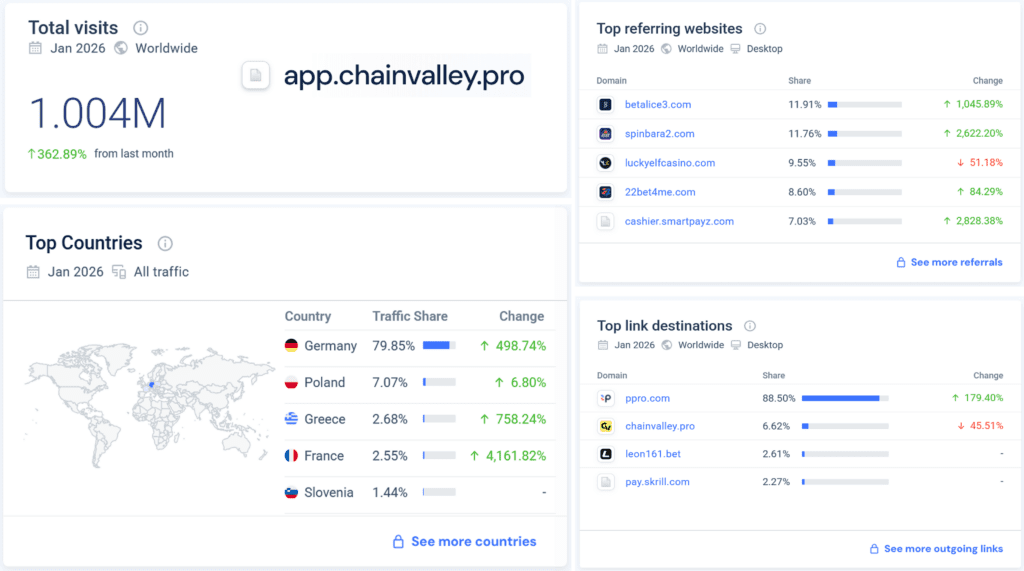
According to Similarweb metrics:
- December 2025: ~250,000 visits to app.chainvalley.pro
- January 2026: 1,000,000+ visits
- Growth rate: approximately +362% month-over-month
This dramatic increase aligns closely with the Lithuanian regulatory tightening under MiCA.
2. The utPay Displacement Effect
When Lietuvos Bankas enforced the MiCA transition framework, utPay — previously a dominant facilitator within iGaming payment flows — experienced a traffic decline of roughly 75%.
ChainValley’s growth curve closely mirrors utPay’s collapse, suggesting a near-direct substitution of rail infrastructure.
3. German Market Concentration
Approximately 80% of ChainValley’s traffic originates from Germany.
This concentration points toward targeted usage by German players depositing at offshore casinos such as DudeSpin, which are not authorised within key EU jurisdictions but continue to localize language and present EU-style payment options.
4. Infrastructure Dependencies
Traffic mapping reveals significant reliance on:
- PPRO (www.ppro.com) — accounting for roughly 90% of outgoing links
- Smartpayz (www.smartpayz.com) — appearing as a top referral source
Smartpayz has previously been flagged within compliance risk reporting environments. The appearance of cashier.smartpayz.com as an upstream referral surface raises operational questions regarding transaction routing.
5. Regulatory Arbitrage
Following the December 2025 presidential veto of Poland’s Crypto-Asset Market Act, Poland remains under a simplified VASP registration regime rather than a full MiCA licensing structure.
This regulatory asymmetry may be enabling a form of cross-border arbitrage within the EU crypto-payment perimeter.
Compliance & Risk Analysis
1. The “Fake FIAT” Structure
ChainValley appears to function as a conversion layer rather than a traditional payment processor.
Operationally, the structure works as follows:
| Step | Player Perception | Actual Backend Flow |
|---|---|---|
| 1 | Standard bank transfer or card payment | FIAT funds received |
| 2 | Payment for “service” | Instant crypto conversion |
| 3 | Casino account funded | Crypto forwarded to offshore operator |
The result:
The player’s bank sees a transaction classified as a crypto purchase rather than a gambling deposit, effectively bypassing gambling-related blocking mechanisms.
This structure reframes the economic reality of the transaction.
2. PSD2 and Licensing Perimeter
If ChainValley — as a VASP registrant — is functionally acting as a FIAT collection agent or money remitter tied to casino deposits, critical PSD2 questions arise:
- Under which authorisation chain is the FIAT leg executed?
- Which licensed payment institution (if any) is responsible?
- What merchant category codes (MCCs) are applied?
- Is gambling classification disclosed upstream?
Poland’s RDWW register does not constitute a financial services licence. Public treasury communications have clarified that virtual currency registration is not equivalent to regulated financial supervision under PSD2. Oversight primarily concerns AML/CFT controls.
3. Regulatory Migration: Lithuania to Poland
The early-2026 Lithuanian tightening — affecting utPay and CoinsPaid (Dream Finance) — imposed full MiCA standards:
- €125,000 minimum capital
- “Fit and Proper” management checks
- Enhanced compliance scrutiny
In contrast, Poland currently maintains a simplified VASP registration regime.
The result: migration of high-risk payment flows.
4. Gambling-by-Conversion
The core mechanism behind these rails is not merely payment innovation. It can be described as “gambling-by-conversion.”
The structure:
- An offshore casino advertises EU-friendly payment methods.
- A player selects a bank transfer or card option.
- The payment rail converts the deposit into crypto.
- Funds are routed to the casino under a different transactional classification.
This is not a neutral technical detail. It is a compliance architecture decision.
Working Hypothesis
There is a significant discrepancy between ChainValley’s Terms & Conditions (which prohibit illegal gambling) and observable traffic behavior.
This gap suggests either:
- Weak compliance enforcement, or
- Structured tolerance designed to capture displaced utPay market share.
Further documentation is required to determine which.
Partner Risk Exposure
PPRO
Questions requiring clarification:
- What contractual relationship exists between PPRO and ChainValley?
- Which merchant accounts are onboarded?
- What MCC classification is used?
- What gambling geoblocking policies are applied?
PPRO publicly presents itself as a local payment enabler for merchants. If its infrastructure is indirectly supporting FIAT legs tied to offshore casino funding, regulatory scrutiny may intensify.
Smartpayz
Key observations:
- cashier.smartpayz.com appears as a high-volume referral source.
- Smartpayz’s public site contains disclaimers suggesting informational status.
- The “cashier” subdomain appears operationally transactional.
Smartpayz has previously been blacklisted in compliance profiling environments.
Call for Documentation
If you are:
- A player who made deposits through ChainValley
- A bank compliance professional
- A PSP insider
- A dispute handler
- Or directly involved in chargeback investigations
We require documentation, not anecdotes.
Please provide:
- Deposit confirmation screenshots (showing payee/beneficiary)
- Bank statement entries with references
- ChainValley order pages or crypto quote screens
- Wallet output confirmations
- Chargeback or complaint correspondence
- Casino cashier screenshots (advertised method vs. actual routing)
Submit materials securely via the Scam-Or Project whistleblower section (anonymous submissions accepted).
The more transaction evidence is collected, the faster the full merchant chain can be mapped and the accountable regulated entities identified.