
Offshore Casinos Exposed: The “Fake FIAT” Mechanism and the Polish–Cypriot Payment Web Behind SpinFin

A renewed forensic review of SpinFin Casino, operating through SpinFin5.com, uncovers a highly structured payment ecosystem engineered to sidestep EU and UK regulatory controls.
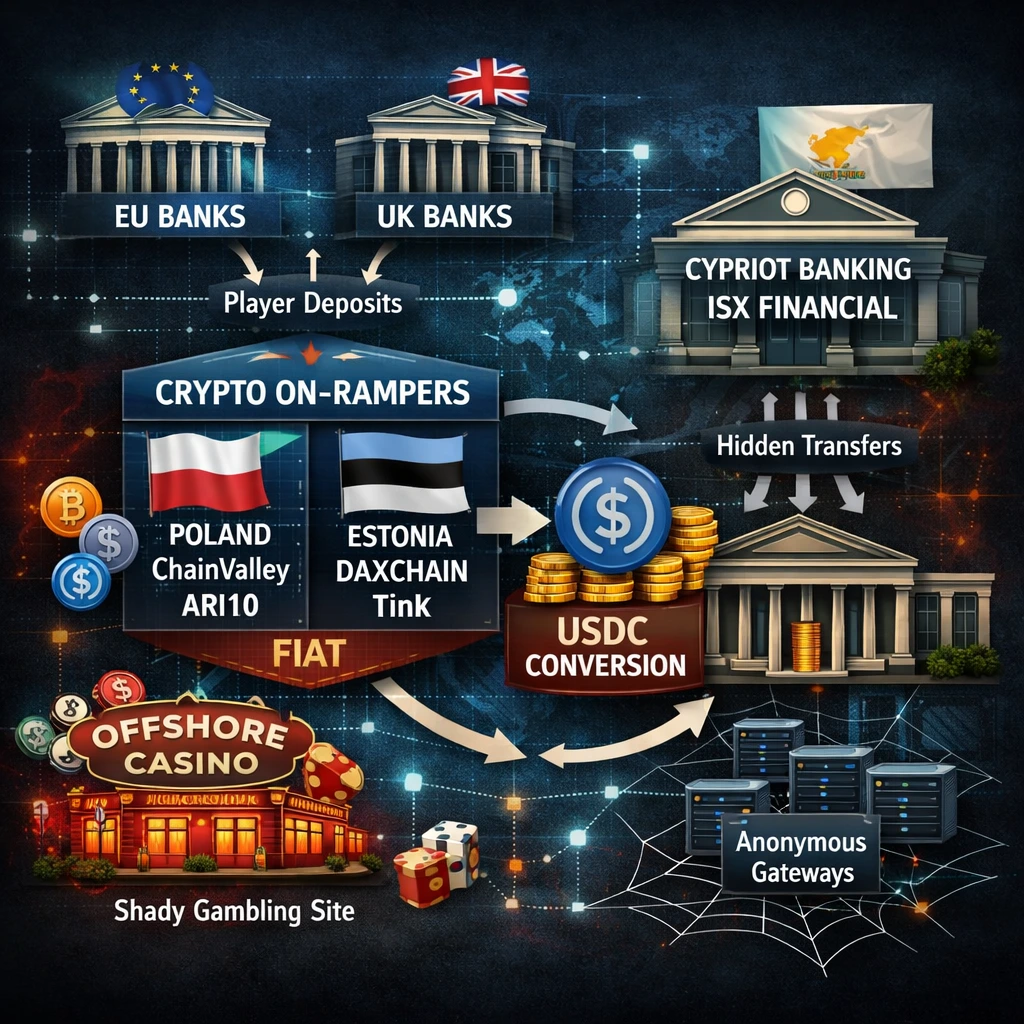
At the center of this system lies the so-called “Fake FIAT” infrastructure — deposit channels that appear to be traditional bank or e-wallet payments but are, in reality, instant crypto on-ramping operations. User funds are swiftly converted into cryptocurrencies, predominantly USDC, before being delivered to the casino operator through third-party intermediaries.
Recent structural adjustments indicate:
- A shift from Lithuanian facilitators toward Polish crypto intermediaries such as ChainValley and ARI10, following increased pressure from the implementation of MiCA regulations.
- Continued reliance on Cypriot banking infrastructure, particularly ISX Financial EU PLC, for settlement and gateway processing.
1. MiFinity and the Costa Rican Operator Node
Our investigation confirms that deposits from EU and UK players via MiFinity are funneled to 102-945295 SRL, a Costa Rica–registered entity.
Key Findings:
- Entity: 102-945295 SRL
- Registration Jurisdiction: Costa Rica
- Gaming Registration: Tobique Gaming Commission (TGC)
- Operational Role: Central payment agent and transactional node within the SpinFin structure
Regulatory Context:
The Tobique Gaming Commission (TGC) does not possess legal authority to license gambling activities within the EU or UK. Nevertheless, 102-945295 SRL appears to function as a transactional bridge between regulated payment systems and the offshore casino backend.
2. “Sofort Uber” – The Cypriot Settlement Corridor
The deposit method labeled “Sofort Uber” operates as a masking layer comprising four anonymized gateway domains.
Gateway Domains:
- api.PWay.com
- debitly.tech
- transactionhandler.com
- sofortuberweisung.com
Settlement Infrastructure:
- Bank: ISX Financial EU PLC
- Location: Cyprus
- IBAN: CY44 9040 0001 0009 7008 3170 1000
Despite regulatory scrutiny in Cyprus, ISX Financial EU PLC continues to serve as a settlement endpoint for high-risk offshore transaction flows routed through these gateways.
3. Bank Transfer – The “Tink-to-DAXCHAIN” Conversion Rail
The “Bank Transfer” option is presented to players as a conventional FIAT transaction. However, technically it operates as an instant crypto purchase.
Transaction Architecture:
- Crypto On-Ramper: DAXCHAIN OÜ (Estonia)
- Open Banking Provider: Tink (a VISA subsidiary)
- Process:
- Player initiates a standard bank transfer interface.
- Tink processes the FIAT transfer to DAXCHAIN OÜ.
- DAXCHAIN converts funds into USDC.
- Crypto is forwarded to the casino operator.
This structure effectively obscures the gambling nature of the transaction from the originating bank record.
4. Revolut Deposits and the ARI10 / Bitcan Route
For Revolut users, the crypto conversion is handled by the Polish group ARI10, operating via Bitcan / Bitcoin Sp. z o.o.
Operational Flow:
- Funds move to a temporary wallet (0xf79…).
- Assets are immediately forwarded to a final destination wallet (0x97b…).
- Transactions are explicitly labeled “irreversible.”
The “irreversible” designation strongly indicates crypto-backed payment processing disguised as consumer payment activity.
5. The Polish Realignment: ChainValley Replacing utPay
With Lithuania tightening oversight under MiCA, crypto provider utPay has been displaced by ChainValley (Poland).
ChainValley’s Current Role:
- Powers Skrill, Neteller, and Rapid Transfer rails.
- Acts as crypto on-ramper converting e-wallet deposits into digital assets.
- Operates under Poland’s temporary MiCA grandfathering regime.
This regulatory window provides an operational buffer enabling continued servicing of offshore operators.
6. PaySafeCard and the SegoPay Routing Layer
Deposits through PaySafeCard are routed via multiple redirect layers before settlement.
Transaction Path:
api.pgway.com → tx.segopay.com → PaySafeCard
Infrastructure:
- Gateway Provider: SegoPay
- Associated Profile: High-risk merchant aggregation and offshore gambling exposure
Payment Infrastructure Overview
| Payment Rail | Primary PayFac / Agent | Jurisdiction | Functional Role | Compliance Position |
|---|---|---|---|---|
| MiFinity | 102-945295 SRL | Costa Rica | Payment Agent | Licensed only via TGC (not EU-recognized) |
| Sofort Uber | ISX Financial EU PLC | Cyprus | Settlement Bank | EMI authorized by Central Bank of Cyprus |
| Bank Transfer | DAXCHAIN OÜ | Estonia | Crypto On-Ramper | VASP / FIU regulated |
| Revolut | Bitcan / ARI10 | Poland | Crypto On-Ramper | VASP (KNF registered) |
| Skrill / Neteller / Rapid | ChainValley | Poland | Crypto On-Ramper | VASP (MiCA transitional period) |
| PaySafeCard | SegoPay / PGWAY | Various | Gateway Aggregator | High-Risk Merchant Channel |
Strategic Assessment: The SpinFin Evasion Framework
The SpinFin model illustrates a modern offshore compliance workaround:
- Shift regulatory friction away from the casino itself.
- Utilize regulated crypto on-rampers in Poland and Estonia.
- Convert FIAT into USDC before regulatory scrutiny occurs.
- Present consumer-facing payment descriptors that conceal gambling exposure.
By the time regulators or banks review transaction records, the funds have already been converted into stablecoins and transferred onward, effectively neutralizing traditional compliance triggers.
Call for Documentation
If you possess documentation relating to:
- The contracting legal entity behind SpinFin5 / SpinFin
- Merchant-of-record disclosures
- Reused destination wallets across additional casino brands
- Bank accounts or EMI relationships tied to these payment rails
Please submit relevant materials securely via the Scam-Or Project whistleblower section.
Screenshots of payment confirmations, email correspondence, wallet traces, and bank descriptors are especially valuable for ongoing analysis.