
The Payvision Files

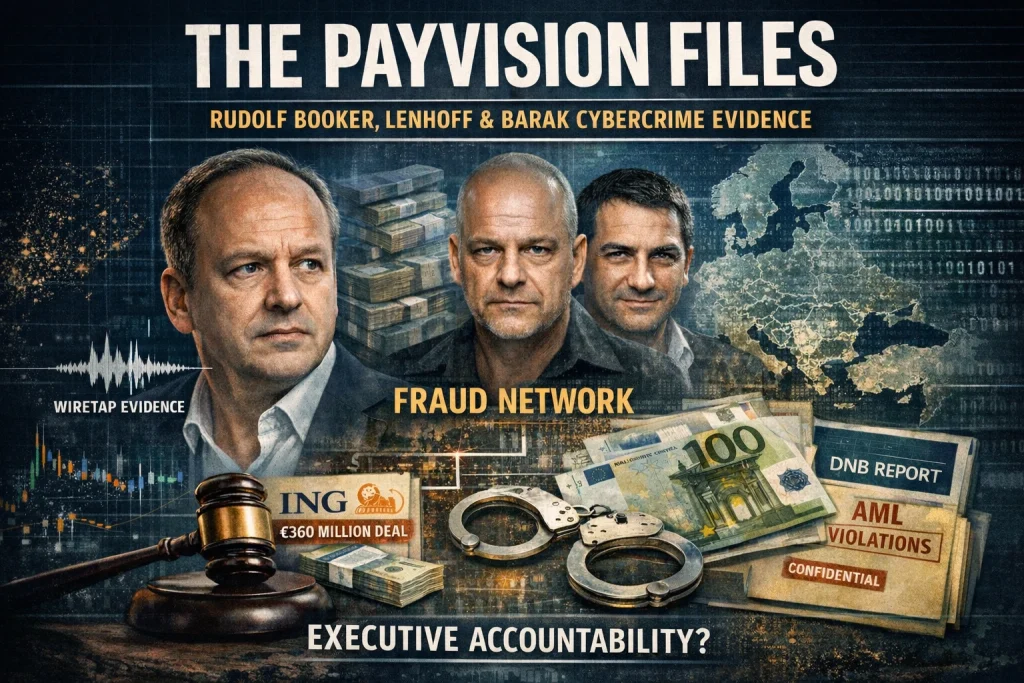
New File Excerpts Point to CEO-Level Involvement in the Lenhoff–Barak Cybercrime Network
One of Europe’s largest cybercrime investigations—spanning dozens of indictments and civil claims by victims—placed the Dutch payment processor Payvision at the operational center of a massive fraud infrastructure. Newly reviewed criminal file excerpts obtained by Scam-Or Project draw then-CEO Rudolf Booker into uncomfortable proximity with the Lenhoff–Barak scam network.
The material does not portray a detached, neutral PSP. Instead, it reveals a CEO closely monitoring media exposure, discussing reputational fallout, and weighing how to preserve a business relationship that—given the mounting red flags—should arguably have been terminated.
Key Findings at a Glance
- A wiretapped call transcript captures Rudolf Booker expressing concern about what a journalist from an investigative outlet might “write about me now—about Payvision.” Uwe Lenhoff reportedly replied: “Maybe that you’re doing business on the grey market.”
- Telegram chats from December 2018 show Lenhoff telling Gal Barak: “Rudolf is a pussy… he will become very famous on this page (an investigative outlet)… [They will] dig deeper in PV.”
- The evidence aligns with longstanding allegations that Payvision functioned as a critical payment chokepoint for the Lenhoff–Barak fraud ecosystem.
- ING acquired a 75% stake in Payvision at a reported valuation of €360 million and later announced the wind-down of Payvision’s PSP and acquiring services.
- In April 2024, the Dutch prosecution service Openbaar Ministerie issued penalty orders (fines of €150,000 and €180,000) against two former Payvision directors for structural and prolonged AML/CFT (Wwft) violations.
- The central unresolved issue: if internal records demonstrate awareness and operational entanglement, why has there been no public courtroom accountability for top-level decision-makers?
The Lenhoff–Barak Cybercrime Network
Investigations by German and Austrian authorities established that Uwe Lenhoff (Germany) and Gal Barak (Israel) orchestrated a pan-European fraud network built on online trading, binary options, and gambling schemes. The network defrauded tens of thousands of victims of more than €100 million.
Judicial Outcomes
| Individual | Jurisdiction | Outcome |
|---|---|---|
| Gal Barak | Vienna, Austria | Convicted in 2020 for investment fraud and money laundering; sentenced to multiple years in prison |
| Uwe Lenhoff | Germany | Arrested January 2019; died in custody in 2020 under sudden and unexplained circumstances |
Barak was identified as a central figure within the E&G Bulgaria structure. Courts in Vienna confirmed the criminal character of the schemes operated through numerous online brands.
These prosecutions did not emerge in isolation. They were supported by a payment backbone that enabled large-scale victim deposits and cross-border laundering. That infrastructure prominently included Payvision and its founder and CEO, Rudolf Booker.
Payvision’s Position in High-Risk Markets
Payvision, headquartered in the Netherlands, operated as a card acquirer and payment processor in sectors long associated with heightened fraud and money-laundering exposure—online gambling, forex, and speculative trading platforms.
In 2018, ING acquired a 75% stake in Payvision at a valuation of approximately €360 million. This transaction monetized years of rapid growth, including high-risk merchant flows linked to Lenhoff and Barak.
DNB Supervisory Findings
The Dutch central bank (DNB) later conducted an extensive supervisory investigation into Payvision. Its findings described systemic violations of the Dutch Anti-Money Laundering and Counter-Terrorist Financing Act (Wwft), highlighting:
- Persistent deficiencies in customer due diligence
- Long-standing failures in ongoing transaction monitoring
- Onboarding and retention of high-risk merchants despite clear warning signs
- Hundreds of internal alerts and suspicious transaction indicators
According to DNB’s reporting, compliance obligations were effectively sidelined in favor of transaction volume growth.
Subsequent developments included:
- A criminal complaint filed by DNB in 2021 against Payvision and Rudolf Booker personally (as reported in related coverage).
- ING’s decision to wind down Payvision and surrender its license by mid-2023.
For founders and executives, however, the financial exit had already materialized through the ING acquisition.
Under established European AML and criminal-law standards, a financial institution and its responsible managers may incur liability if they knowingly provide payment infrastructure to fraudulent enterprises despite evident red flags.
Analysis: The “Payvision Laundromat” Allegations
Wiretapped calls and digital communications suggest that the relationship between Rudolf Booker and Uwe Lenhoff extended beyond a distant commercial arrangement.
Lenhoff reportedly referred to Booker as a “friend” and invited him to private celebrations. The file excerpts indicate:
1. Awareness of Fraud
Booker allegedly knew that Lenhoff and Gal Barak—sometimes dubbed the “Wolf of Sofia”—were operating fraudulent platforms such as Option888 and XTraderFX. Despite high chargeback ratios and numerous suspicious activity reports (SARs), Payvision continued processing transactions exceeding €131 million.
2. Active Evasion Tactics
When chargebacks from defrauded consumers escalated, Booker allegedly suggested alternative transaction coding and the use of new legal entities to mitigate scrutiny from card networks.
3. Profit Maximization
Evidence indicates that Payvision imposed additional fees or “private penalties” on Lenhoff and Barak’s operations tied to chargebacks—effectively increasing Payvision’s revenue in advance of the ING acquisition.
The December 2018 Chats
WhatsApp exchanges dated 25–26 December 2018 between “UL” (Uwe Lenhoff) and “Gal” (Gal Barak) reveal escalating tensions after Payvision informed Barak that accounts were being shut down.
Lenhoff reportedly wrote:
“Rudolf is a pussy… and I told him that now he will become very famous on this page, cause when this WB [editor of an investigative outlet] is seeing that he is right, he will dig deeper in PV.”
Why This Matters
- Lenhoff recognized reporting by an investigative outlet as leverage against Payvision.
- The messages suggest Booker was reacting to media pressure.
- They indicate a mutual exposure dynamic inconsistent with Payvision being an unwitting victim.
- The exchanges imply that scam operators perceived the CEO as vulnerable due to regulatory and reputational risk.
Legal Assessment: Contributing Perpetrator?
DNB’s supervisory conclusions established systematic compliance failures at Payvision. While two former directors received penalty orders from the Openbaar Ministerie, the broader question remains whether executive-level knowledge rises to the threshold of aiding and abetting fraud or money laundering.
The €360 million valuation underpinning ING’s acquisition was built on transaction volumes that included flows derived from fraudulent activity. Lenhoff died in custody. Barak received a prison sentence. Booker, by contrast, has not faced equivalent criminal prosecution to date.
ING’s Exit and Continuing Litigation
ING closed Payvision’s operations after determining that its risk profile and historical conduct were incompatible with regulatory standards. Nevertheless, civil litigation continues.
Victims are pursuing claims in Austria, Germany, and the Netherlands, seeking compensation for losses attributed to the Lenhoff–Barak schemes and the associated payment infrastructure.
Call for Insiders: Submit Information Securely
The investigation into the alleged “Payvision Laundromat” remains ongoing. Scam-Or Project is seeking further information regarding:
- Internal Payvision or ING communications about the Lenhoff and Barak accounts
- The structure and rationale of additional fees or “private penalties”
- Evidence of deliberate compliance overrides by senior management
If you possess relevant information, you can submit it confidentially via the Scam-Or Project whistleblower section. Anonymity and source protection remain a priority.