
Impaya and Aceiro: The Hidden Routing Layer Behind Casino Payments and Paysolo

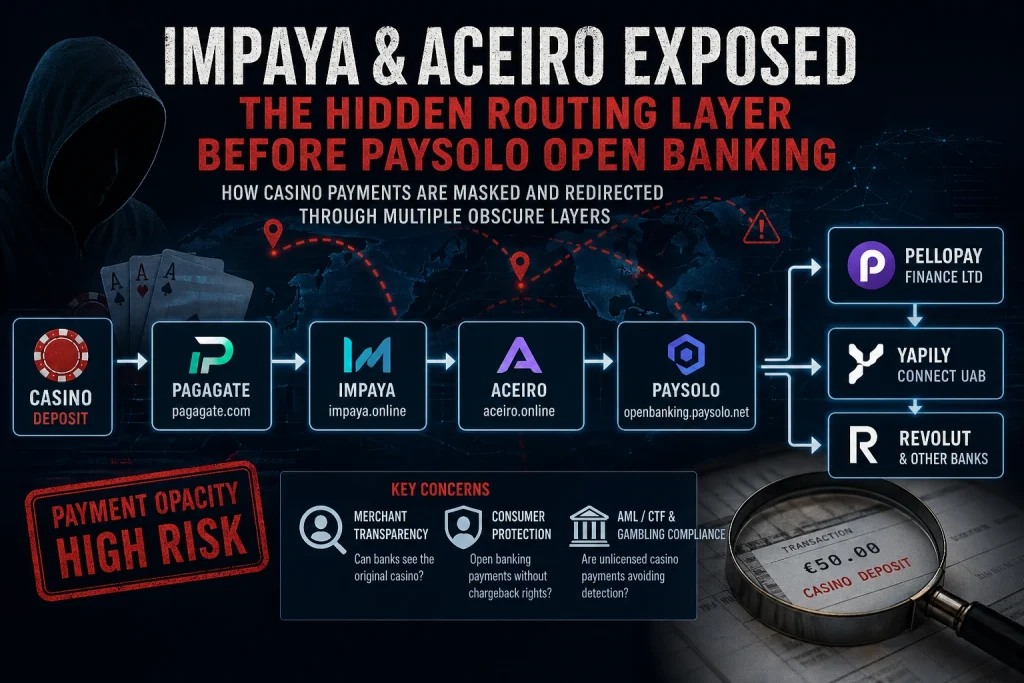
New whistleblower material reviewed by Scam-Or Project suggests that casino deposit transactions may travel through a multi-step redirect chain before reaching the Paysolo open-banking interface. The identified sequence — Pagagate → Impaya.online → Aceiro.online → openbanking.paysolo.net — indicates that Impaya and Aceiro could act as intermediary routing or masking layers between casino-facing payment gateways and the final open-banking execution stack involving Paysolo, Pellopay, Yapily, and Revolut.
Key Findings
-
Video and screenshot evidence reveal a sequential redirect path:
pagagate.com → impaya.online → aceiro.online → openbanking.paysolo.net - Impaya positions itself publicly as an e-commerce payment solutions provider offering customizable online payment systems and infrastructure.
- Impaya lists NewTech Mobile SIA (registration number 40103709254, Skanstes str 7 k1, Riga, Latvia) as its EU representative.
- Professional profiles link Sergejs Roslikovs to both Impaya and NewTech, identifying him as CEO of IMPAYA Payment System and CEO of NewTech SIA.
- Aceiro.online appears within the active payment flow, but its corporate ownership remains unclear and should be treated as a technical routing domain pending further verification.
- Paysolo is not just theoretical in this setup: it markets itself as a EUR–crypto bridge with virtual IBAN services, supporting SEPA/SWIFT rails and crypto conversion.
- Pellopay appears later in the payment consent layer, promoting API-based payment integrations, transaction traceability, settlements, and support for banking options including Revolut.
Observed Payment Flow
Based on whistleblower footage and screenshots, the transaction path appears as follows:
Casino deposit page → Pagagate → Impaya.online → Aceiro.online → openbanking.paysolo.net → Pellopay / Yapily consent layer → bank selection (including Revolut EU)
This structure is significant. It demonstrates that before a user even reaches the Paysolo open-banking interface, at least two additional routing layers — Impaya and Aceiro — may already be involved.
Why Impaya and Aceiro Are Critical
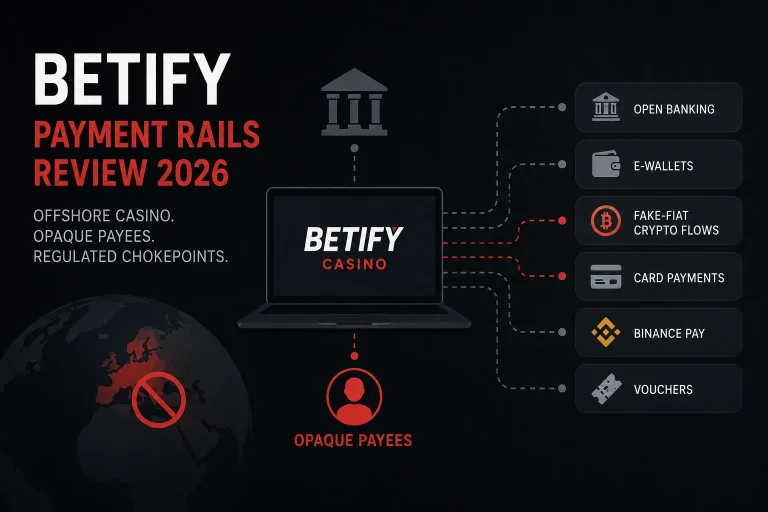
Additional observations indicate that Aceira.online and Paysolo appear in similar open-banking payment flows across other casino and betting platforms operating without proper licensing, often via payment agents in Cyprus. One example includes Betify.
This suggests that a recurring payment infrastructure exists in this high-risk segment, centered around Paysolo and supported by upstream layers like Impaya and Aceiro.
Both domains appear to function before the Paysolo stage and are not transparently explained to the end user. Instead, they display generic messages such as:
“Payment processing… Please wait, your payment is being processed.”
Potential Functions and Compliance Implications
| Possible Function | Compliance Relevance |
|---|---|
| Redirect orchestration | Obscures original merchant journey |
| Payment-session handling | Generates or maintains transaction tokens |
| Gateway masking | Separates casino brand from bank-facing layer |
| Risk-based routing | Directs payments depending on region or bank |
| Merchant abstraction | Complicates identification of merchant of record |
The Layered Casino Payment Architecture
The evolving Rail Atlas model now looks as follows:
Offshore casinos
↓
Pagagate / Urbenics
↓
Impaya.online
↓
Aceiro.online
↓
openbanking.paysolo.net
↓
Pellopay Finance LTD
↓
Yapily Connect
↓
Revolut / other banks
This is not a conventional payment chain. It represents a modular, multi-entity stack where each layer may be controlled by a different operator, hosted on separate domains, and subject to varying levels of regulatory oversight.
Compliance Analysis
1. The “Processing Page” Mechanism
Impaya and Aceiro appear as neutral processing screens. While such pages can be legitimate in standard payment routing, in high-risk gambling scenarios they may reduce transparency by fragmenting the transaction path.
The key concern is whether these pages remove contextual data before the transaction reaches the open-banking layer.
2. Impaya’s Public Positioning
Impaya presents itself as a provider of scalable, secure payment solutions with full-service capabilities. Its LinkedIn presence reinforces this positioning.
This aligns with its apparent role in the observed flow — potentially acting as a routing or orchestration layer. However, Scam-Or Project notes that formal confirmation is required before making definitive claims about its contractual involvement.
3. The Role of NewTech Mobile SIA
Public disclosures confirm NewTech Mobile SIA as Impaya’s EU representative. This provides a tangible regulatory contact point within the European Union.
This detail is important for regulators and financial counterparties seeking clarification about the observed payment routing structure.
4. Aceiro: The Least Transparent Layer
Aceiro remains the most opaque component. While it is clearly present in the transaction flow, no confirmed corporate operator has been identified.
This makes it a prime subject for further investigation — a domain-level routing layer with unclear ownership, contractual role, and regulatory standing.
Evidence & Confidence Table
| Entity / Layer | Observed Role | Evidence Type | Confidence |
|---|---|---|---|
| Pagagate.com | Casino-facing gateway | Video / screenshots | Corroborated |
| Impaya.online | Redirect/payment-processing layer | Video / screenshots | Corroborated |
|
Impaya impaya.com |
Payment solutions provider | Website / LinkedIn | Confirmed |
| Impaya Payments Ltd | Canadian payment entity | Public sources | Confirmed |
| Paytech Solutions PTE LTD | Singapore representative |
Public sources (Contact page) |
Confirmed |
|
NewTech Mobile SIA newtech.lv |
EU representative |
Official disclosure (LinkedIn page) |
Confirmed |
| Sergejs Roslikovs | CEO | Confirmed | |
| Aceiro.online | Intermediate routing layer | Video / screenshots | Corroborated |
| openbanking.paysolo.net | Open-banking interface | Video / screenshots | Confirmed |
| Pellopay Finance LTD | Payment consent layer | Screenshots / public info | Corroborated |
| Yapily Connect UAB | Open-banking connector | Payment footer / public info | Corroborated |
| Revolut | Bank endpoint | Video / screenshots | Confirmed |
Key Questions to Impaya / NewTech Mobile
- Does Impaya operate or control impaya.online?
- Does it provide routing or gateway services to Pagagate, Urbenics, Paysolo, or casino operators?
- What is the relationship between Impaya, NewTech Mobile SIA, Aceiro, and Pagagate?
- Are services provided to casinos such as Luckzie.io, Kingdomcasino.io, Jinxcasino.io, or Kingdomcasino6.io?
- What due diligence is conducted for gambling clients?
- Who is identified as the merchant of record?
- Are open-banking flows via Paysolo, Pellopay, or Yapily supported?
Key Questions to Aceiro
- Who owns and operates aceiro.online?
- Is Aceiro a PSP, routing domain, white-label gateway, or affiliate infrastructure?
- Why does it appear between Impaya and Paysolo?
- Does it maintain transaction logs identifying the original merchant?
- Which providers (PSPs, PISPs, open-banking systems) does it connect to?
Regulatory Considerations
The Impaya/Aceiro layer appears to be where transaction opacity significantly increases. A user begins with a casino transaction, but by the time the process reaches Paysolo and further to Pellopay or Yapily, the original context may be reduced to a technical payment session.
This raises key regulatory concerns:
- Merchant transparency: Can financial institutions identify the original casino?
- Consumer protection: Do users understand they are initiating open-banking payments without chargeback rights?
- AML/CTF compliance: Are unlicensed gambling payments routed in a way that bypasses detection mechanisms such as MCC 7995?
Conclusion
The Impaya and Aceiro findings provide a clearer picture of the upstream routing layer in complex casino payment infrastructures. While Paysolo is the visible open-banking gateway and Pellopay/Yapily operate downstream, Impaya and Aceiro appear to function earlier in the chain — acting as a concealed bridge between casino payment gateways and regulated banking interfaces.
This is where compliance risks intensify: the original gambling context may be fragmented or obscured before reaching banks such as Revolut.
Working hypothesis:
Impaya and Aceiro may operate as intermediate routing layers within a multi-step casino payment architecture feeding into Paysolo’s open-banking system and downstream banking APIs.
Scam-Or Project Whistleblower Call
Scam-Or Project invites insiders, payment providers, compliance professionals, casino staff, and affected users to share information confidentially via the Scam-Or Project website.
We are particularly interested in:
- Redirect chains and URL logs
- Merchant agreements and contracts
- Payment descriptors and settlement records
- KYC documentation
- Communication with Impaya or NewTech Mobile
- Evidence identifying the operator behind Aceiro
Confidential submissions can help clarify the structure and accountability of this payment ecosystem.