
Betify Payment Rails Review: Offshore Casino Funding Network, Open Banking Chokepoints, and Opaque Merchant Structures

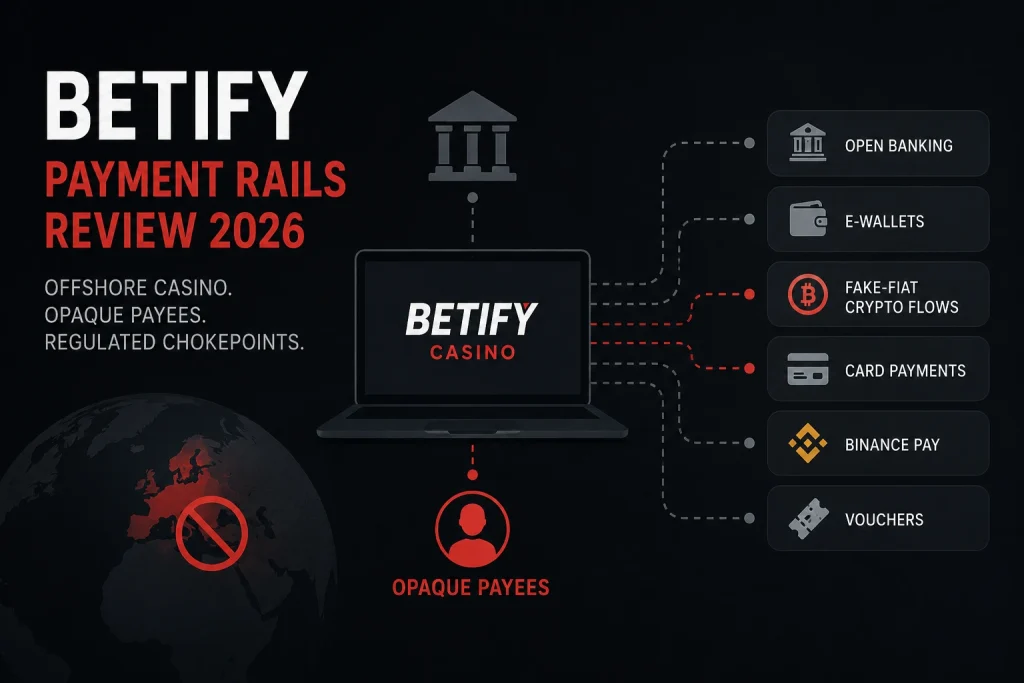
A May 2026 review conducted by Scam-Or Project identified a significantly expanded payment architecture behind Betify compared to the platform’s August 2024 setup. While the visible corporate structure changed from Altacore N.V. / Altaprime Limited to Fortuna Games N.V. / Deltaprime Limited, the broader operational model appears largely unchanged.
The latest review indicates that EU users could still access and initiate deposits to the offshore casino through a fragmented network of payment processors, open banking gateways, crypto-conversion flows, wallets, card processors, voucher systems, and third-party payees that obscure the actual gambling beneficiary.
Key Findings
Corporate Structure Was Replaced, But the Model Stayed the Same
In the August 2024 review, Betify was associated with:
- Altacore N.V. (Curaçao)
- Altaprime Limited (Cyprus)
In the May 2026 review, the visible entities became:
- Fortuna Games N.V. (Curaçao)
- Deltaprime Limited (Cyprus)
Although the company names changed, the jurisdictional arrangement remained substantially identical: a Curaçao-based offshore gambling operator combined with a Cyprus-facing payment and EEA representation layer.
EU Users Could Still Access and Fund Accounts
During the May 6, 2026 simulated review, registration and deposit flows remained available from EU jurisdictions despite no verified evidence that Betify possessed the necessary gambling licenses in those territories.
Open Banking Flow Exposed InstantBankPayment and Yapily
The bank-transfer route directed users to:
- checkout.instantbankpayment.com
The interface displayed bank-selection screens together with Yapily Connect authorization terms.
The Revolut authorization page specifically referenced:
- Yapily Connect UAB
This Lithuanian regulated payment institution is supervised by the Bank of Lithuania under authorization number LB002045.
The review raises questions regarding:
- merchant onboarding,
- transaction-purpose verification,
- AML screening,
- and jurisdictional controls.
Passpoint Sp. z o.o. Appeared as the Payee
In the Revolut and Wise bank-transfer flow, the visible recipient was not Betify, Fortuna Games N.V., or Deltaprime Limited.
Instead, the payee shown was:
- Passpoint Sp. z o.o. (Poland)
This creates a notable merchant-of-record opacity issue because the visible payment recipient differs from the gambling brand presented to players.
Yapily’s Role in InstantBankPayment Remains Unclear
The screenshots confirmed that Yapily authorization and legal disclosures appeared inside the flow. However, the evidence did not conclusively establish whether Yapily owns or directly controls checkout.instantbankpayment.com.
Further clarification would be required.
MiFinity Deposits Used Buscarar LLC
The MiFinity payment rail displayed:
- Buscarar LLC
as the recipient instead of Betify or the named operator entities.
This adds another intermediary layer between the player and the actual gambling beneficiary.
Skrill and Neteller Functioned as Fake-FIAT Crypto Rails
One of the most significant findings involved Skrill and Neteller.
Users selecting familiar wallet payment methods were redirected to:
- Nylo
- app.nylo.pro
The transaction was framed as a crypto purchase and transfer rather than a direct fiat wallet payment.
The user was required to confirm:
- the purchase of cryptocurrency,
- and the transfer of that crypto to a specified wallet address.
The reviewed screens did not disclose:
- the origin of the crypto,
- the owner of the destination wallet,
- or the ultimate beneficiary.
Nylo Operated as a Crypto-Purchase Intermediary
Nylo publicly presents itself as a payment gateway supporting multi-currency transactions through its own infrastructure and partners.
The reviewed Betify flow showed Nylo acting as a conversion intermediary between:
- Skrill / Neteller
- and downstream crypto transfers.
ChainValley’s Role Was Not Confirmed
While ChainValley has appeared in similar fake-FIAT casino payment structures in other investigations, the May 2026 review did not confirm ChainValley’s direct involvement in the Betify flow.
Skrill eps Rail Displayed Deskimopay
The eps payment rail powered by Skrill displayed:
- Deskimopay
as the recipient rather than the gambling operator itself.
Card Payments Used a Multi-Layer Routing Structure
The observed card-payment chain was:
| Step | Payment Layer |
|---|---|
| 1 | Betify cashier |
| 2 | checkout.processingpsp.co |
| 3 | tx.segopay.com |
| 4 | api.axipays.com |
| 5 | Skrill |
| 6 | BLUETECH GBP |
The tested payment showed:
- “BLUETECH GBP”
as the card descriptor and recipient reference.
This creates additional concerns regarding:
- descriptor opacity,
- acquiring relationships,
- payment facilitation,
- and transaction coding transparency.
Binance Pay Was Routed Through CryptonBTC
The Binance Pay option first redirected users through:
- pay2.cryptonbtc.com
before reaching Binance Pay itself.
Public information regarding CryptonBTC remains extremely limited.
Flexepin Was Available as a Voucher Deposit Option
The cashier also included:
- Flexepin
which adds a prepaid-style, cash-like funding mechanism to the overall payment stack.
Evidence Assessment
| Finding | Evidence Grade | Basis |
|---|---|---|
| Betify accessible from EU jurisdictions | Confirmed | Simulated review and screenshots |
| Fortuna Games N.V. and Deltaprime Limited identified | Confirmed | FAQ and corporate references |
| Altacore N.V. and Altaprime Limited identified in 2024 | Confirmed | Earlier Scam-Or Project review |
| Yapily terms shown in InstantBankPayment flow | Confirmed | Screenshots |
| Yapily Connect UAB regulated under LB002045 | Confirmed | Bank of Lithuania disclosures |
| Yapily controls InstantBankPayment | Unverified | Screenshots insufficient |
|
Passpoint Sp. z o.o. shown as payee (LinkedIn profile) |
Confirmed | Screenshots and Polish registry |
| Nylo used in Skrill/Neteller crypto flow | Confirmed | Payment screenshots |
| ChainValley linked to this flow | Unknown | No direct evidence |
| Buscarar LLC shown in MiFinity flow | Confirmed | Screenshots |
| Deskimopay appeared in eps flow | Confirmed | Screenshots |
| BLUETECH GBP appeared in card flow | Confirmed | Test transaction |
| Axipays present in routing chain | Confirmed | Screenshots and public references |
| CryptonBTC routed Binance Pay | Confirmed | Screenshots |
Then vs Now: Betify Payment Architecture
| Area | August 2024 | May 2026 | Compliance Interpretation |
|---|---|---|---|
| Operator | Altacore N.V. | Fortuna Games N.V. | Corporate wrapper replaced |
| Cyprus Layer | Altaprime Limited | Deltaprime Limited | EU-facing structure persists |
| Main Concern | Offshore access + open banking | Multi-rail fragmented architecture | Increased complexity |
| Open Banking | Present | Expanded | Higher regulated exposure |
| Crypto Conversion | Limited | Extensive | Greater AML complexity |
| Main Risk | Offshore gambling funding | Merchant opacity and fake-FIAT rails | Elevated compliance concerns |
Core Finding 1: Offshore Structure Was Repackaged
The visible migration from Altacore/Altaprime to Fortuna/Deltaprime should not automatically be interpreted as remediation.
The central issue remains unchanged if EU consumers can still:
- register,
- deposit funds,
- and access gambling services
through payment infrastructure that does not transparently identify the actual merchant or gambling beneficiary.
From a compliance perspective, this kind of restructuring should trigger enhanced due diligence by payment providers and banking partners.
Core Finding 2: Open Banking Flow and Passpoint Sp. z o.o.
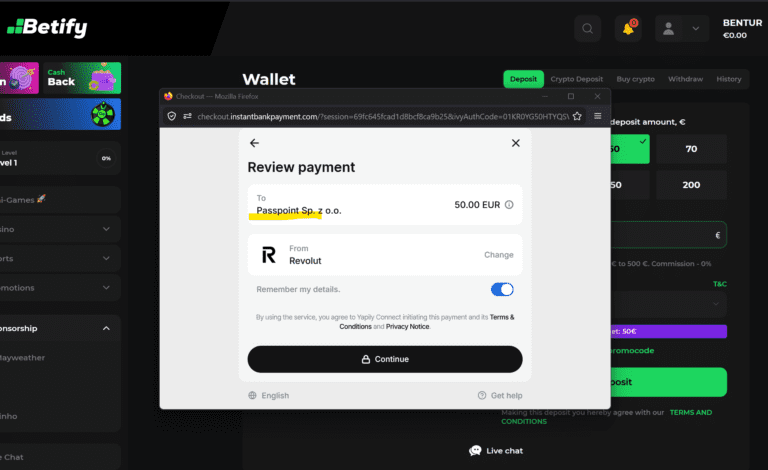
The open banking rail directed users into a flow involving:
- InstantBankPayment,
- Yapily Connect UAB,
- Revolut,
- Wise,
- and Passpoint Sp. z o.o.
The appearance of a Polish third-party company as the visible payee instead of the gambling operator raises questions regarding:
- merchant-of-record transparency,
- transaction monitoring,
- AML controls,
- consumer disclosure,
- and gambling-related payment classification.
Polish corporate registry data identifies Passpoint Sp. z o.o. under KRS 0001139121. Publicly accessible company information and LinkedIn-linked references associate the entity with Adejuwon Oyebanjo (LinkedIn) and Kelechi Uchegbulem (LinkedIn).
Core Finding 3: Fake-FIAT Crypto Conversion
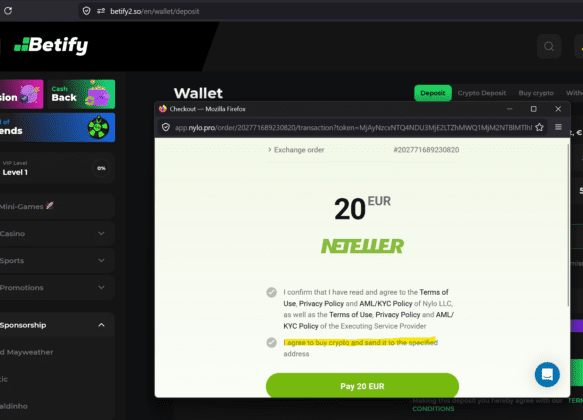
The Skrill and Neteller rails represented one of the strongest findings of the review.
Although the user selected what appeared to be standard wallet payments, the underlying transaction was actually structured as:
- crypto purchase,
- crypto transfer,
- onward routing to undisclosed wallet infrastructure.
This structure potentially changes the regulatory and AML profile of the transaction entirely.
It may also reduce:
- consumer transparency,
- recovery expectations,
- and visibility into the ultimate beneficiary.
Core Finding 4: MiFinity and Buscarar LLC
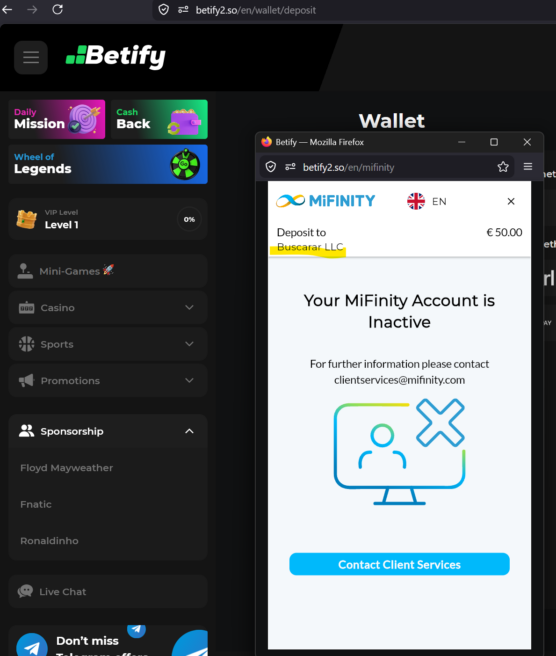
MiFinity deposits displayed Buscarar LLC rather than the operator itself.
This creates uncertainty regarding:
- who the contractual merchant is,
- who receives settlement,
- and whether the actual gambling beneficiary is fully disclosed inside the regulated payment chain.
Core Finding 5: eps/Skrill and Deskimopay
The eps rail powered by Skrill exposed another unrelated recipient layer through:
- Deskimopay
Local bank-transfer systems such as eps and MyBank are generally perceived by users as traditional banking rails.
The use of unrelated recipient identities inside offshore gambling flows raises further transparency concerns.
Core Finding 6: Card Routing Through Multiple Intermediaries
The Visa payment chain involved several intermediate domains and processing layers before ultimately surfacing:
- BLUETECH GBP
as the descriptor.
The structure raises classic payment-processing concerns involving:
- descriptor mismatches,
- hidden merchant relationships,
- payment orchestration opacity,
- and possible transaction-laundering exposure.
Core Finding 7: Binance Pay and CryptonBTC
The Binance Pay route involved:
- CryptonBTC,
- pay2.cryptonbtc.com,
- and Binance Pay.
The lack of public transparency surrounding CryptonBTC creates additional uncertainty regarding:
- merchant onboarding,
- destination wallet ownership,
- and payment-purpose monitoring.
Compliance Analysis
1. Merchant-of-Record Opacity
The dominant pattern across the reviewed rails was the separation between:
- the gambling brand,
- the visible payee,
- and the actual transaction recipient.
Users encountered names such as:
- Passpoint,
- Buscarar LLC,
- Deskimopay,
- Nylo,
- BLUETECH GBP
instead of the named gambling operator.
This appears to be the core compliance concern throughout the architecture.
2. Regulated Chokepoints Exist Inside the Flow
The most significant exposure may not be the offshore casino itself, but the regulated providers facilitating the rails, including:
- Yapily Connect UAB,
- Revolut,
- Wise,
- MiFinity,
- Skrill,
- Neteller,
- Paysafe,
- Binance Pay,
- SegoPay,
- Axipays,
- and associated card-acquiring infrastructure.
These entities represent the critical supervision and AML chokepoints.
3. Fake-FIAT Structures Increase AML Complexity
The Nylo-based crypto conversion structure blurred the distinction between:
- fiat deposits,
- wallet funding,
- crypto purchases,
- and crypto transfers.
This creates material risks related to:
- AML monitoring,
- sanctions compliance,
- source-of-funds verification,
- and travel-rule obligations.
4. Open Banking Rails Require Heightened Oversight
Account-to-account open banking rails are:
- fast,
- difficult to reverse,
- and often less dispute-oriented than card payments.
When used for offshore gambling flows, payment providers and bank endpoints face elevated compliance obligations.
5. Descriptor and Payee Mismatch
The repeated appearance of unrelated descriptors and third-party recipients should trigger enhanced scrutiny by:
- banks,
- acquirers,
- PSPs,
- card schemes,
- wallet providers,
- and open banking operators.
Conclusion
The May 2026 Betify review does not indicate a simplified or remediated payment structure.
Instead, the evidence points to a broader and more fragmented architecture involving:
- open banking rails,
- fake-FIAT crypto conversions,
- card-processing intermediaries,
- Binance Pay routing,
- voucher systems,
- and multiple opaque third-party payees.
Although the visible corporate wrapper changed from:
- Altacore N.V. / Altaprime Limited
to:
- Fortuna Games N.V. / Deltaprime Limited
the underlying risk profile appears materially similar.
The strongest regulatory pressure points are not only the offshore gambling operators themselves, but also the payment providers and intermediaries enabling access to EU consumers while obscuring:
- merchant identity,
- transaction purpose,
- and settlement beneficiaries.
This represents a classic Rail Atlas scenario in which the payment infrastructure itself becomes the primary compliance concern.
Whistleblower Request
Scam-Or Project invites:
- PSP employees,
- compliance officers,
- former Betify insiders,
- crypto-payment specialists,
- bank investigators,
- wallet-provider employees,
- and payment orchestration experts
to provide confidential information regarding:
- Betify,
- Fortuna Games N.V.,
- Deltaprime Limited,
- Altacore N.V.,
- Altaprime Limited,
- Passpoint Sp. z o.o.,
- Nylo,
- Buscarar LLC,
- Deskimopay,
- BLUETECH GBP,
- InstantBankPayment,
- Yapily Connect UAB,
- Revolut,
- Wise,
- MiFinity,
- Skrill,
- Neteller,
- Paysafe,
- Binance Pay,
- CryptonBTC,
- SegoPay,
- Axipays,
- and related settlement accounts or wallet infrastructure.
Information may be submitted confidentially through the Scam-Or Project Complaints.