
Revolut Rail Atlas: Open Banking Corridor Linking Paysolo, Pagagate, Urbenics, and Offshore Casinos

A follow-up analysis by Scam-Or Project within the Revolut Rail Atlas series focuses on openbanking.paysolo.net, a gateway positioned between anonymous casino-oriented payment layers and the Open Banking infrastructure of Revolut.
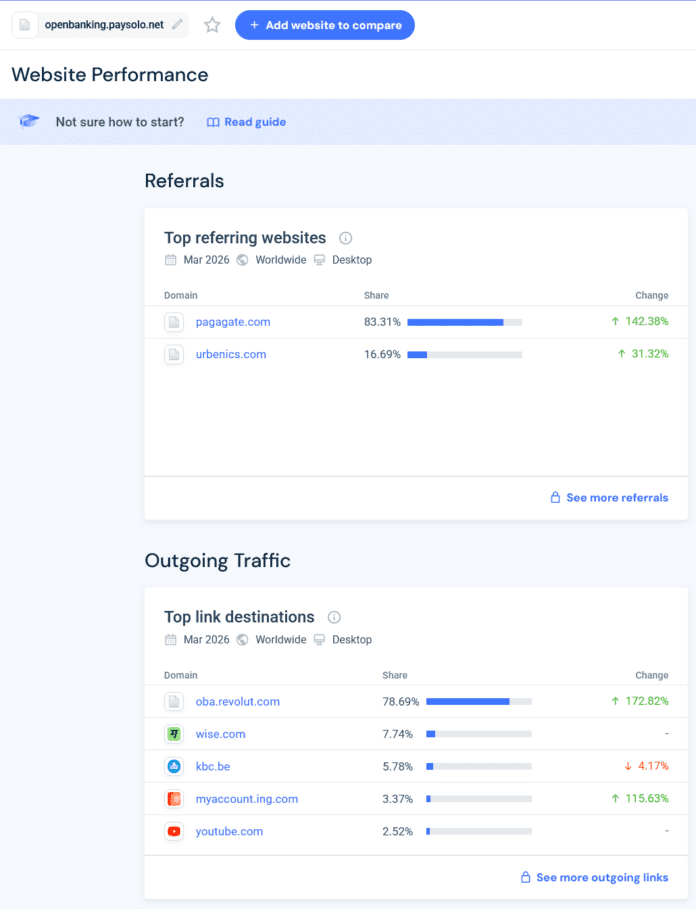
Traffic intelligence sourced from SimilarWeb indicates that in March 2026, all inbound referrals to this gateway originated from Pagagate and Urbenics, while over 78% of outbound traffic was directed to oba.revolut.com.
This supports a working assumption: Paysolo may function as a hybrid crypto and open-banking bridge embedded in a multi-layered casino payment ecosystem.
Key Findings
- Paysolo O.O.D. is presented as a Bulgarian entity (registration №207268330), listed in the National Revenue Agency VASP register.
- The platform promotes itself as:
- a virtual IBAN provider
- a EUR-to-crypto conversion service
- a SEPA/SWIFT-enabled fiat gateway
- The endpoint openbanking.paysolo.net is publicly accessible and operational.
- Traffic patterns suggest:
- Pagagate and Urbenics are the only visible inbound sources
- Revolut Open Banking (oba.revolut.com) is the dominant outbound destination
- Both Pagagate and Urbenics have been observed in casino-related payment flows, indicating that Paysolo could be embedded within offshore iGaming payment chains.
- The relationship between paysolo.io and paysolo.net remains unclear:
- paysolo.io → corporate/marketing interface
- paysolo.net → gateway labeled “PaySolo – Your payment partner,” referencing Newtech Mobile
Revolut Rail Map: The Paysolo Flow
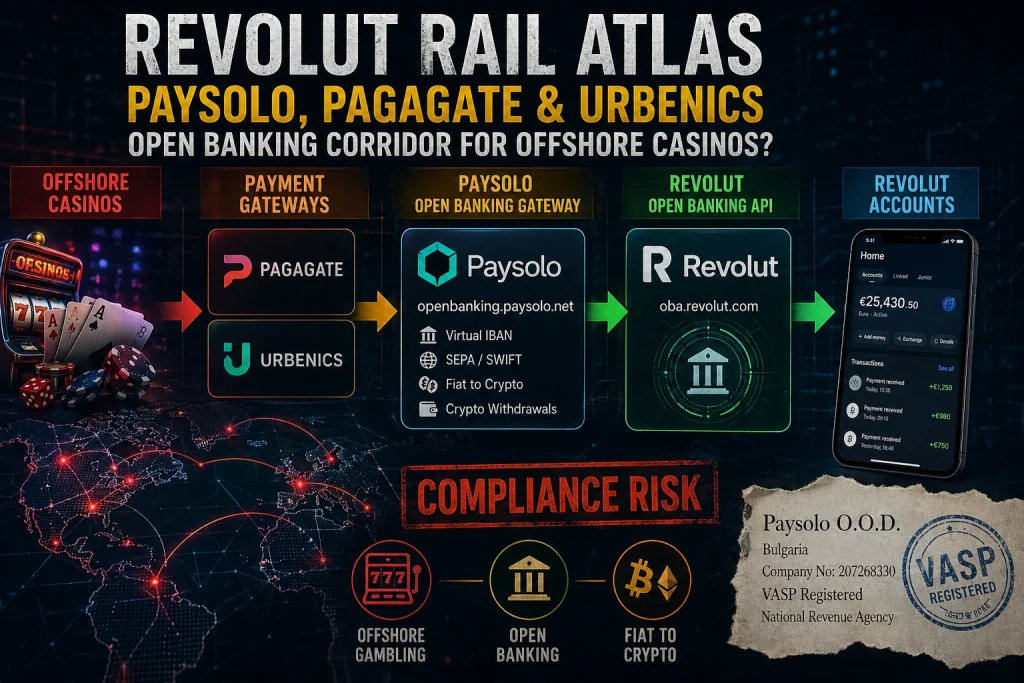
The observed payment structure can be summarized as:
Casino interface → Pagagate / Urbenics → openbanking.paysolo.net → Revolut Open Banking API → Revolut account
This reflects the multi-layered “rail” architecture previously identified by Scam-Or Project.
The concern is not merely the presence of Revolut, but its position downstream of potentially casino-linked intermediaries.
Paysolo: Infrastructure Layer or Casino Middleware?
Paysolo’s service stack includes:
- Virtual IBAN accounts
- SEPA and SWIFT transfers
- Crypto exchange functionality
- Payment processing services
According to its public materials:
- Users send EUR to a virtual IBAN
- Funds are converted into crypto
- Assets are withdrawn to external wallets
Such a model is legitimate in isolation. However, within a casino payment context, it becomes a potential conversion layer between regulated banking and crypto-based settlement environments.
Scam-Or Project does not claim that Paysolo knowingly supports illegal gambling. However, available data suggests that its open-banking gateway processes traffic originating from casino-facing payment layers and routes it toward Revolut’s API.
SimilarWeb Traffic Analysis (March 2026)
| Domain | Observation | Compliance Interpretation |
|---|---|---|
| openbanking.paysolo.net | Referrals: Pagagate (83.31%), Urbenics (16.69%) | 100% traffic from two gateway sources |
| Outgoing: oba.revolut.com (~80%) | Revolut is dominant downstream endpoint | |
| pagagate.com | Sends ~46.83% to Paysolo; also linked to aphrodite1.casino | Indicates dual connection to gateway + casino |
| urbenics.com | Referrals from Boomerang Bet, Casinoly, Posido, Vegasino, Skyhills | Strong casino-facing profile |
| Outgoing ~80% to Paysolo | Acts as feeder into Paysolo |
The dataset suggests over 309,000 visits to openbanking.paysolo.net in March 2026 — indicating a significant operational node rather than a marginal endpoint.
Why This Matters for Revolut
Previous Rail Atlas findings highlighted a recurring structure:
- Offshore casinos
- Anonymous gateways
- Open banking intermediaries
- Bank APIs (including Revolut)
The Paysolo case sharpens this model:
Urbenics / Pagagate → Paysolo → Revolut
Key compliance questions:
- Does Revolut see upstream transaction context or only final payment instructions?
- Are repeated flows from high-risk intermediaries monitored?
- How are these transactions categorized (crypto, gambling, P2P, merchant)?
- Can open banking obscure the true origin (casino vs. standard transfer)?
The primary concern is the intersection of three high-risk domains:
- Offshore gambling
- Open banking
- Fiat-to-crypto conversion
Corporate & Regulatory Context
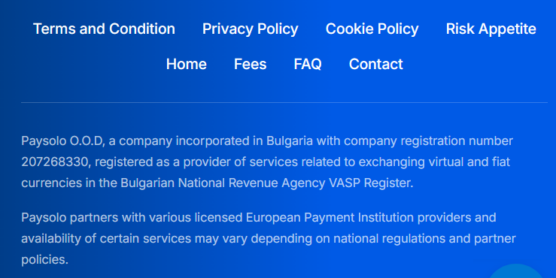
- Entity: Paysolo O.O.D. (Bulgaria)
- Registration: National Revenue Agency VASP register
- Services include:
- paysolo.io
- app.paysolo.io
- virtual IBAN solutions
- crypto exchange
- payment processing
It is important to note:
VASP registration does not authorize processing of illegal gambling flows.
Compliance obligations remain:
- AML controls
- Source-of-funds verification
- Transaction monitoring
- Sanctions screening
- Fraud detection
Evidence & Confidence Overview
| Element | Role | Evidence | Jurisdiction | Confidence |
|---|---|---|---|---|
| Paysolo O.O.D. | Legal entity | Website disclosures | Bulgaria | Confirmed |
| paysolo.io | Corporate platform | Public site | Bulgaria | Confirmed |
| paysolo.net | Gateway interface | Public access | Unclear | Indicated |
| openbanking.paysolo.net | Open banking node | Endpoint + traffic data | Unclear | Corroborated |
| Pagagate | Traffic source | SimilarWeb | Unknown | Corroborated |
| Urbenics | Casino gateway | SimilarWeb | Unknown | Corroborated |
| oba.revolut.com | Bank API destination | SimilarWeb | UK / EEA | Corroborated |
| Casino domains | Source layer | Observations | Offshore | Corroborated |
Compliance Analysis
1. Paysolo as a Conversion Layer
Its structure aligns with systems capable of bridging bank payments to crypto, which is sensitive when tied to gambling flows.
2. Role of Pagagate and Urbenics
These gateways appear closely connected to casino environments, forming the upstream layer feeding Paysolo.
3. Revolut as the Final Banking Endpoint
With nearly 80% outbound traffic directed to oba.revolut.com, Revolut emerges as the primary downstream node.
4. Transparency Risks in Open Banking
Compared to card acquiring systems, open banking may lack:
- Merchant category codes
- Descriptor clarity
- Chargeback mechanisms
- Gambling filters
This can obscure the real economic nature of transactions.
Key Questions for Paysolo
- Is Paysolo O.O.D. the operator behind paysolo.net and openbanking.paysolo.net?
- What is the connection with Newtech Mobile?
- Does Paysolo provide services to Pagagate or Urbenics?
- Are gambling-related merchants onboarded or processed?
- Are upstream domains screened before transactions?
- How many flows in March 2026 originated from these gateways?
- Is origin data passed to downstream banks like Revolut?
- Are gambling-origin crypto conversions allowed?
- Have suspicious activity reports been filed?
Key Questions for Revolut
- Is openbanking.paysolo.net classified as a high-risk counterparty?
- Does Revolut receive upstream origin data (Pagagate, Urbenics, casinos)?
- How are these transactions categorized internally?
- Have flows linked to these entities been restricted or reported?
- Do gambling-blocking mechanisms apply to open banking via VASP intermediaries?
Conclusion
The Paysolo case represents a critical node in the evolving open banking payment architecture linked to offshore gambling.
The structure is straightforward but impactful:
Casino gateways → Paysolo → Revolut
While this does not confirm deliberate facilitation of illegal activity, it clearly illustrates a growing compliance risk:
multi-layered payment systems can transform high-risk casino-origin funds into seemingly standard banking transactions.
For regulators and financial institutions, the implication is clear:
open banking must not become a blind spot for gambling-related and crypto-linked financial flows.
Whistleblower Call
Scam-Or Project encourages insiders, compliance professionals, developers, and affected users to submit confidential information via the Scam-Or Project whistleblower section.
Relevant materials include:
- API logs
- Merchant agreements
- Transaction records
- Payment descriptors
- Screenshots
- VASP onboarding documentation
- Internal compliance alerts
Particular interest is placed on evidence involving Paysolo, Pagagate, Urbenics, and casino-linked open-banking transactions.