
Rail Atlas Investigation: Revolut, Open Banking, and the Hidden Casino Payment Infrastructure

The latest Rail Atlas analysis by Scam-Or Project highlights a recurring pattern involving Revolut and its Open Banking interface within complex offshore iGaming payment flows. These structures appear to combine anonymous gateways, intermediary open-banking providers, and Revolut’s own payment ecosystem.
While this does not constitute evidence of deliberate involvement by Revolut, it raises critical compliance concerns around transaction monitoring, merchant transparency, and whether offshore casino payments may represent an underreported growth channel within one of Europe’s fastest-expanding fintech platforms.
Key Findings
-
Revolut repeatedly appears in casino payment chains
Scam-Or Project identified multiple offshore casino payment routes where transactions ultimately lead to oba.revolut.com, often routed via open-banking intermediaries. -
Multi-layered structure is intentional
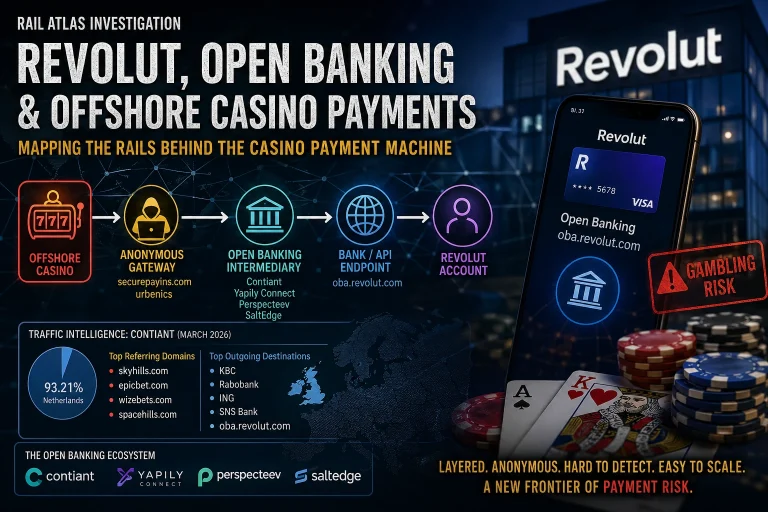
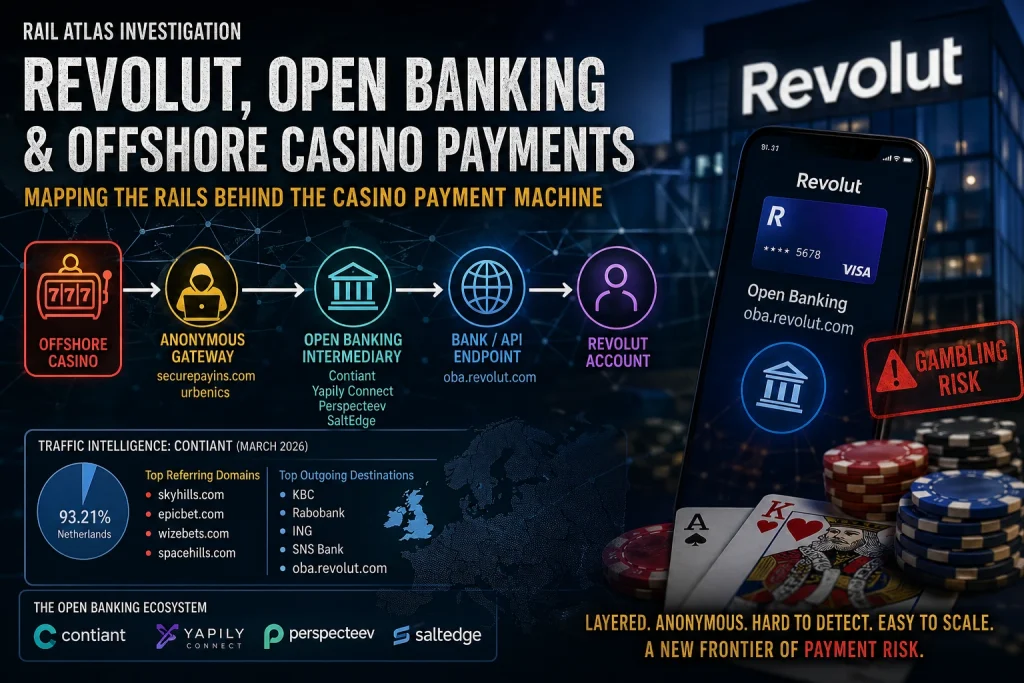
Typical flow structure:Casino platform → anonymous gateway → open-banking provider → banking/API endpoint
-
Contiant traffic signals potential risk
Traffic intelligence suggests strong links between casino domains and open-banking routing layers connected to Revolut. -
Revolut acknowledges gambling-related risks
The company states it blocks transactions linked to illegal gambling where required by regulators. -
Revolut Business policies prohibit gambling activity
UK Business Terms explicitly list gambling and binary options among restricted activities. -
No explicit iGaming segmentation in financial reports
Revolut’s 2025 report shows massive growth, but lacks direct disclosure of casino-related exposure. -
Financial crime risks are recognized internally
Over one-third of Revolut’s workforce operates in financial crime prevention, with systems analyzing billions of transactions.
Rail Map: Typical Casino Payment Flow
Scam-Or Project outlines the following working model:
Player → Offshore casino → anonymous gateway → open-banking intermediary → Revolut Open Banking endpoint → Revolut account
Observed Payment Rail Components
| Layer | Examples | Compliance Concern |
|---|---|---|
| Casino front-end | Skyhills, Epicbet, Wizebets, Spacehills | Offshore / unlicensed gambling exposure |
| Gateway layer | securepayins.com, urbenics | Lack of merchant transparency, laundering risk |
| Open banking | Contiant, Yapily Connect, Perspecteev, SaltEdge | Payment routing abstraction |
| Bank/API endpoint | oba.revolut.com | Revolut infrastructure involvement |
Core issue:
The concern is not simply gambling activity by users — but whether repeated, structured flows through Revolut-linked infrastructure form identifiable casino payment corridors requiring enhanced compliance action.
Revolut’s Role in the Payment Ecosystem
Revolut describes its Open Banking API as a gateway enabling third-party providers to access accounts and initiate payments.
However, in observed cases:
- Payments are not always processed as standard gambling transactions
- They are routed through intermediaries and gateway domains
- This may obscure the true merchant origin
As a result, transactions may appear as:
- Generic account transfers
- Gateway payments
- Customer-authorized operations
Key question:
Can Revolut reliably detect that these payments originate from offshore casino activity when routed through multiple layers?
The Open Banking Layer: Intermediaries in Focus
Contiant and Related Infrastructure
Contiant, along with providers such as Yapily, Perspecteev, and Salt Edge, plays a central role in these flows.
Traffic Intelligence Insights
- 93.21% of Contiant traffic (March 2026) originated from the Netherlands
- Casino domains such as:
- skyhills.com
- epicbet.com
- wizebets.com
-
spacehills.com
appear among top referral sources - Outgoing traffic includes banks like:
- KBC
- Rabobank
- ING
- SNS Bank
- oba.revolut.com
This does not prove wrongdoing, but strongly suggests that Contiant may function as a routing layer for casino-related payments.
Traffic Intelligence Interpretation
| Observation | Interpretation | Confidence |
|---|---|---|
| Casino domains dominate Contiant referrals | High exposure to gambling-related traffic | Confirmed |
| Netherlands accounts for 93%+ traffic | Dutch market central to this ecosystem | Confirmed |
| oba.revolut.com among outgoing links | Revolut is part of downstream flow | Confirmed |
| ~1.1M visits to oba.revolut.com (March 2026) | Significant Open Banking scale | Internal data |
| Gateway layering before banking | Possible merchant obfuscation | Hypothesis |
Important:
Traffic analytics indicate patterns — not legal responsibility or contractual relationships, but they can highlight recurring structures used in offshore gambling payment flows, including cases where intermediaries and fintech solutions are involved in bypassing national restrictions, as described by Scam-Or Project in a related investigation.
Financial Perspective: Hidden Exposure?
Revolut’s 2025 report does not explicitly disclose iGaming exposure. However, key metrics include:
- 68.3 million retail customers
- £986 billion retail transaction volume
- 767,000 business clients
- £277 billion business transaction volume
- £4.5 billion total revenue
- 22.2% from card payments
- 228% YoY growth in payment acceptance
Additionally:
- Financial crime risks are acknowledged as material
- Illegal use of services could lead to fines, enforcement, or reputational damage
Conclusion:
If casino-related flows exist at scale, they are likely embedded within broader transaction categories.
Regulatory Context
Revolut confirms:
- Some jurisdictions require blocking payments to illegal gambling operators
- It enforces regulator-issued blacklists where applicable
This is especially relevant in countries like Norway, where financial institutions must block transactions linked to unlicensed gambling providers (source).
Compliance Assessment
Scam-Or Project identifies five critical monitoring layers:
- Casino domains feeding open-banking providers
- Repeated deposits to offshore gateway domains
- Open-banking initiation involving high-risk intermediaries
- Geographic concentration (e.g., Netherlands, Norway)
- Mismatch between transaction descriptors and actual activity
Key insight:
Open banking may lack clear merchant category codes (e.g., MCC 7995), creating a compliance blind spot.
Evidence & Confidence Overview
| Entity | Role | Evidence | Jurisdiction | Confidence |
| Revolut (oba.revolut.com) | Payment endpoint | Traffic + rail analysis | UK / EEA | Confirmed |
| Contiant | Open banking routing | Traffic data | Bulgaria / NL | Confirmed |
| Yapily Connect | Open banking layer | Rail observations | UK / EEA | Confirmed |
| Perspecteev / SaltEdge | Data & routing layer | Observations | EU | Confirmed |
| securepayins.com | Gateway | Observations | Unknown | Confirmed |
| urbenics | Gateway | Observations | Unknown | Confirmed |
| Offshore casinos | Origin merchants | Testing + traffic | Offshore | Confirmed |
Open Questions for Revolut
- Does Revolut monitor upstream casino-related flows via Open Banking?
- Are transactions via Contiant, Yapily, or SaltEdge classified differently?
- Does Revolut track high-risk gateway domains?
- How is illegal gambling identified in open-banking flows?
- Has Contiant been flagged internally as high-risk?
- How many accounts were restricted in 2025 due to gambling activity?
- Are suspicious patterns reported to regulators or FIUs?
- Does monitoring include referral-chain analysis?
- Have regulators in Norway, the Netherlands, UK, or EU raised concerns?
- Is casino-related open-banking traffic considered a material risk?
Conclusion
This Rail Atlas report does not claim that Revolut knowingly supports illegal gambling operations. Instead, it establishes a more precise concern:
Revolut’s Open Banking infrastructure repeatedly appears in offshore casino payment routes that are layered, anonymized, and difficult to classify.
Such structures may introduce a new type of transaction laundering risk — not by hiding funds, but by obscuring the commercial origin of payments.
Future investigations will focus on individual infrastructure elements, including Contiant, Yapily Connect, Perspecteev, SaltEdge, and associated gateway domains.
Whistleblower Call
Scam-Or Project invites insiders, compliance professionals, payment specialists, and affected users to submit confidential information via the Scam-Or Project whistleblower section.
Relevant materials include:
- Payment descriptors
- Gateway agreements
- Merchant onboarding data
- Compliance alerts
- Blocked transactions
- Internal risk evaluations related to offshore casino flows
Confidential sources remain protected.