
Revolut and Payoro: How Norwegian Players Circumvent Offshore Gambling Payment Restrictions


Norway’s strict framework blocking payments to unlicensed gambling platforms is increasingly being sidestepped through a sophisticated, multi-layered payment setup. By leveraging Revolut as an entry wallet and Payoro (https://payoro.com/) as a payout channel, offshore casinos and their partners appear to have engineered an alternative financial pathway for Norwegian users—effectively operating outside the reach of domestic banking controls and regulatory enforcement.
Key Findings
-
Revolut as Primary On-Ramp
Norwegian users rely on Revolut to fund offshore casino accounts, bypassing traditional banking restrictions through e-wallet transfers and open banking mechanisms. -
Payoro as Withdrawal Hub
Payoro is widely utilized by operators such as White Star B.V., Rhino Entertainment Group, and Boabet to process payouts in EUR and NOK back to user-controlled wallets like Revolut. -
Revolut Embedded in Casino Payment Pages
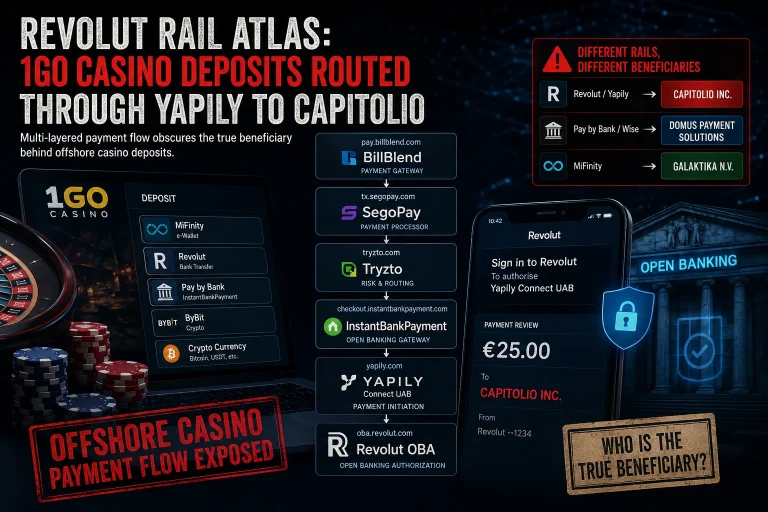
Multiple offshore brands reviewed by Scam-Or Project prominently feature Revolut—often integrated via open banking providers such as Yapily Connect and Contiant—as a preferred banking option for Norwegian customers. -
MCC Manipulation and Transaction Masking
Evidence suggests widespread misclassification of merchant category codes (MCC), allowing gambling-related payments to appear as standard transactions and pass through payment systems undetected. -
KYC as a Reusable Access Layer
Once users complete verification (often via Norwegian BankID) with Revolut and Payoro, the same credentials enable seamless deposits and withdrawals across multiple offshore gambling sites.
Payment Flow Overview
| Step | Description |
|---|---|
| 1 | User transfers funds from a Norwegian bank to Revolut |
| 2 | Funds are routed from Revolut to offshore casinos via cards, e-wallets, or open banking |
| 3 | Casino processes withdrawals through Payoro |
| 4 | Payoro sends funds back to Revolut after KYC verification |
| 5 | Domestic banks only see transactions involving Revolut, not gambling activity |
Analysis and Interpretation
Norwegian regulations prohibit payment service providers from facilitating transactions linked to unlicensed gambling operators. Domestic banks maintain extensive blocklists targeting high-risk merchants and payment intermediaries. However, they are not permitted to universally block transfers to neutral platforms like Revolut, general-purpose e-wallets, or crypto-enabled services.
This regulatory limitation effectively positions Revolut as a structural vulnerability within Norway’s enforcement model.
According to insider insights, the transaction flow is straightforward:
- Users first move funds from local banks into Revolut
- From there, funds are transferred to offshore operators through various payment rails
- Withdrawals are processed via Payoro and routed back to Revolut
At no point does the domestic bank directly register a gambling-related transaction.
Repeated investigations by Scam-Or Project show that Revolut consistently appears at the center of offshore casino payment infrastructures. When combined with open banking layers such as Yapily Connect and Contiant, it effectively operates as a central hub for high-risk gambling transactions involving Norwegian users.
Reports of MCC misclassification and transaction laundering further suggest that financial institutions and regulators may only see a “cleaned” version of these transactions, while the underlying activity remains tied to gambling.
Compliance Hypothesis
The working assumption is that Revolut and Payoro—alongside upstream providers like Yapily Connect and Contiant—form an interconnected, multi-layered payment architecture that systematically bypasses Norway’s restrictions on offshore gambling payments.
While each component may claim neutrality regarding transaction purpose, several factors indicate otherwise:
- Targeted usage patterns among Norwegian gambling users
- Repeated integration into offshore casino payment systems
- Consistent reliance on MCC manipulation
- Delegation of KYC responsibilities across platforms
Taken together, these elements suggest not isolated misuse, but a structured model of regulatory arbitrage.
This raises serious concerns regarding:
- Risk assessment procedures
- Merchant onboarding controls
- AML/CTF compliance frameworks
particularly in tightly regulated jurisdictions such as Norway.
Call for Whistleblowers
Scam-Or Project continues to investigate the involvement of Revolut and Payoro in facilitating offshore gambling payment flows.
We invite:
- Industry insiders
- Compliance professionals
- Affiliates
- Platform users
with relevant knowledge—especially regarding Yapily Connect, Contiant, and similar infrastructures—to share information through the Scam-Or Project whistleblower section.
Your insights may help uncover the full scope of this payment ecosystem and its regulatory implications.