
GoldenBet, Santeda & Payabl: GDPR Records Expose Payment Processing for Offshore Casino Transactions

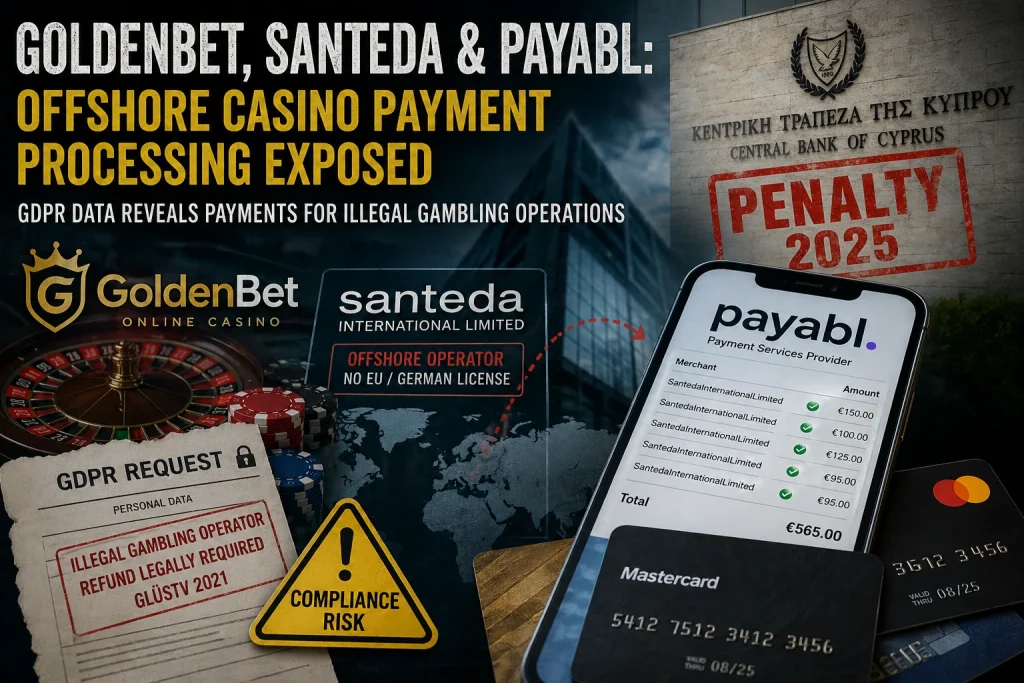
A German player’s GDPR request has uncovered a significant compliance issue involving Payabl, offshore casino operator Santeda International Limited, and the casino brand GoldenBet.
Documents reviewed by Scam-Or Project show that the Cyprus-regulated electronic money institution processed multiple card deposits connected to Santeda International Limited — the payment entity linked to GoldenBet, which reportedly operates without authorization in Germany or broader EU-regulated gambling markets.
Even after receiving direct notice regarding the alleged illegality of the gambling activity and the player’s disclosed gambling addiction, Payabl reportedly declined refund requests, arguing that no direct contractual relationship existed with the player.
The case raises broader concerns surrounding anti-money laundering controls, gambling compliance obligations, merchant onboarding procedures, and regulatory oversight — particularly following enforcement action taken by the Central Bank of Cyprus in 2025.
Key Findings
The available documentation reveals several notable issues:
- Payabl (https://payabl.com/) supplied a transaction list showing multiple successful payments totaling €565
- All transactions were linked directly to Santeda International Limited
- Transaction descriptors openly displayed the merchant’s name
- Payabl acknowledged that it provides payment services to merchant clients
- Refund requests were rejected
- The player explicitly warned Payabl about alleged illegal gambling activity in Germany
- Evidence from MiFinity reportedly confirmed Santeda as the payment beneficiary
- The player disclosed prior gambling addiction and previous self-exclusion history
These factors collectively create a documented compliance concern rather than a purely hypothetical scenario.
Transaction Records Directly Link Payments to Santeda
One of the most significant pieces of evidence is the transaction documentation reportedly provided by Payabl itself.
Transaction Details
| Category | Details |
|---|---|
| Merchant | Santeda International Limited |
| Payment Method | Mastercard |
| Timeline | August 2025 |
| Status | Successful |
| Total Volume | €565 |
Unlike many offshore gambling payment structures that rely on merchant masking or hidden intermediaries, the transaction records reportedly identify Santeda directly.
This eliminates ambiguity regarding the merchant receiving the funds.
GoldenBet and Santeda: Regulatory Concerns
According to the whistleblower statement and supporting payment documentation:
- GoldenBet is allegedly operated by Santeda Group
- The operator reportedly lacks German authorization
- No valid EU gambling license was identified
- German gambling regulations under Glücksspielstaatsvertrag (GlüStV 2021) prohibit unlicensed gambling operations
- Payment facilitation for unauthorized gambling entities may create regulatory exposure
The player reportedly informed Payabl that:
- The operator was allegedly unauthorized
- Agreements may be legally unenforceable
- Refund obligations may exist under unjust enrichment principles
- Previous legal rulings involving related Santeda brands allegedly exist
This significantly increased the compliance risk after Payabl was formally notified.
Payabl’s Official Position
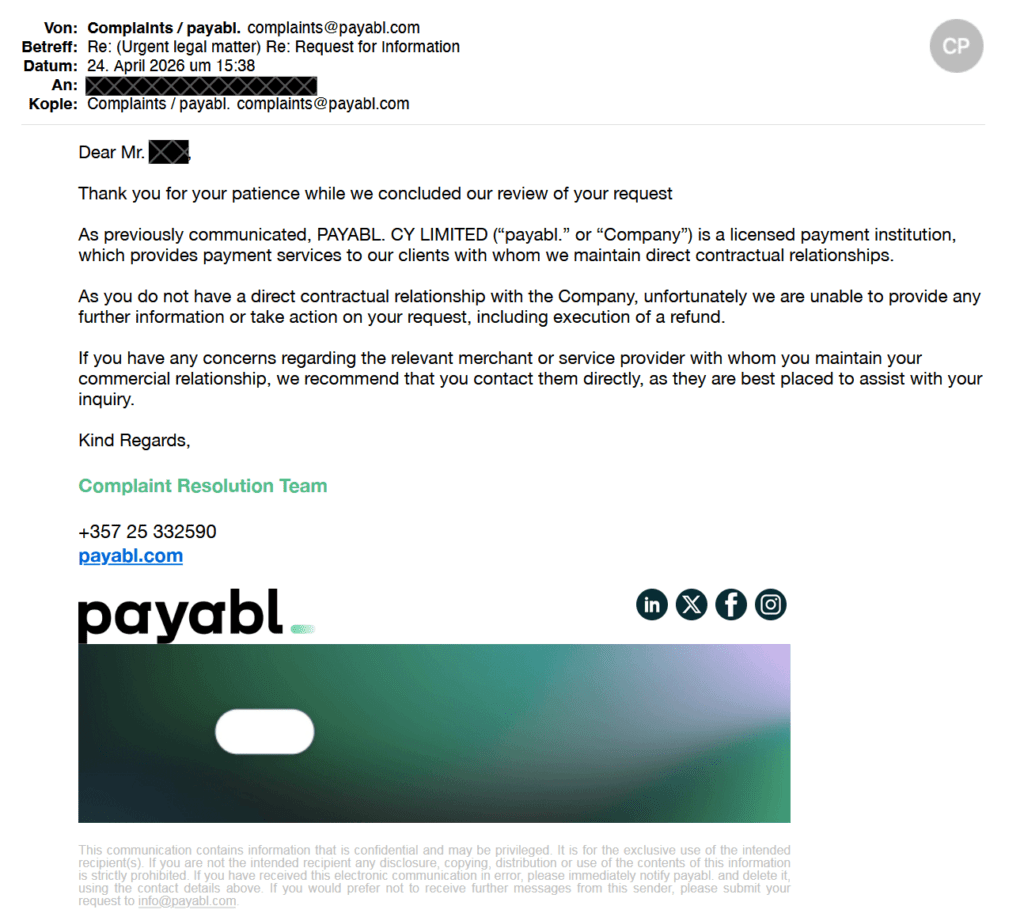
According to documents reviewed by Scam-Or Project, Payabl responded:
“As you do not have a direct contractual relationship… we are unable to execute a refund.”
From a contractual standpoint, this position reflects the standard payment-service structure where processors primarily serve merchants rather than end consumers.
However, critics argue that this explanation does not fully address potential regulatory obligations tied to high-risk merchants.
Compliance Analysis
1. Risk Awareness Was Established
Payabl was reportedly informed that:
- Santeda allegedly operated illegally in Germany
- The player disclosed gambling addiction
- The transactions were allegedly unlawful
- Related litigation reportedly existed
After receiving such information, questions emerge regarding whether additional compliance reviews were required.
2. Merchant Identification Was Clear
This was not a hidden processing structure involving anonymous shell merchants.
The payment records explicitly named Santeda International Limited and showed repeated payment activity.
That creates direct merchant visibility.
3. Potential Payment Facilitation Exposure
Under EU AML frameworks and national gambling laws, payment institutions may be expected to:
- Conduct merchant due diligence
- Monitor transaction activity
- Detect suspicious patterns
- File suspicious activity reports where required
Under Germany’s GlüStV framework, facilitating payments for illegal gambling operations may trigger additional scrutiny.
4. Responsible Gambling Concerns
The player reportedly disclosed:
- Prior self-exclusion in 2022
- Gambling addiction
- Continued access to deposits
If accurate, this may indicate broader consumer protection failures.
Repeated deposits under these circumstances may represent elevated transaction risk.
2025 Central Bank of Cyprus Enforcement Action
The Central Bank of Cyprus reportedly imposed a major AML-related penalty against Payabl in 2025.
According to public records:
- On 12 December 2025
- Payabl Cy Ltd filed Appeal No. 1405/2025
- The appeal was submitted before the Administrative Court
While the enforcement action reportedly focused on AML shortcomings, such penalties often involve:
- Weak merchant due diligence
- Insufficient transaction monitoring
- Poor risk classification
- Failure to detect higher-risk payment flows
Why the GoldenBet Case Matters
| Regulatory Risk | GoldenBet Case |
|---|---|
| High-risk merchant exposure | Santeda offshore gambling operations |
| AML monitoring concerns | Repeated gambling transactions |
| Jurisdiction mismatch | Illegal in Germany |
| Consumer harm indicators | Gambling addiction disclosure |
| Suspicious transaction patterns | Multiple small deposits |
This case may represent a real-world example of the broader compliance weaknesses regulators have already flagged.
Conclusion
This matter is not based on speculation alone.
The available records indicate:
- Payabl processed transactions
- Santeda was identified as the merchant
- GoldenBet allegedly operated without proper licensing
- Payabl was directly informed of the concerns
- Refund requests were denied
This creates a clear tension between contractual payment processor limitations and broader regulatory obligations involving AML controls, merchant oversight, and consumer protection.
Scam-Or Project Whistleblower Request
Scam-Or Project invites insiders connected to:
- Payabl
- Santeda International Limited
- MiFinity
- acquiring banks
- internal compliance teams
to submit:
- Merchant onboarding files
- Internal risk assessments
- SAR documentation
- Compliance alerts
- Transaction monitoring records
through the Scam-Or Project whistleblower section.