
KuCoin EU Refills AML Roles After FMA Business Ban — But Vienna’s Regulatory Verdict Remains Outstanding

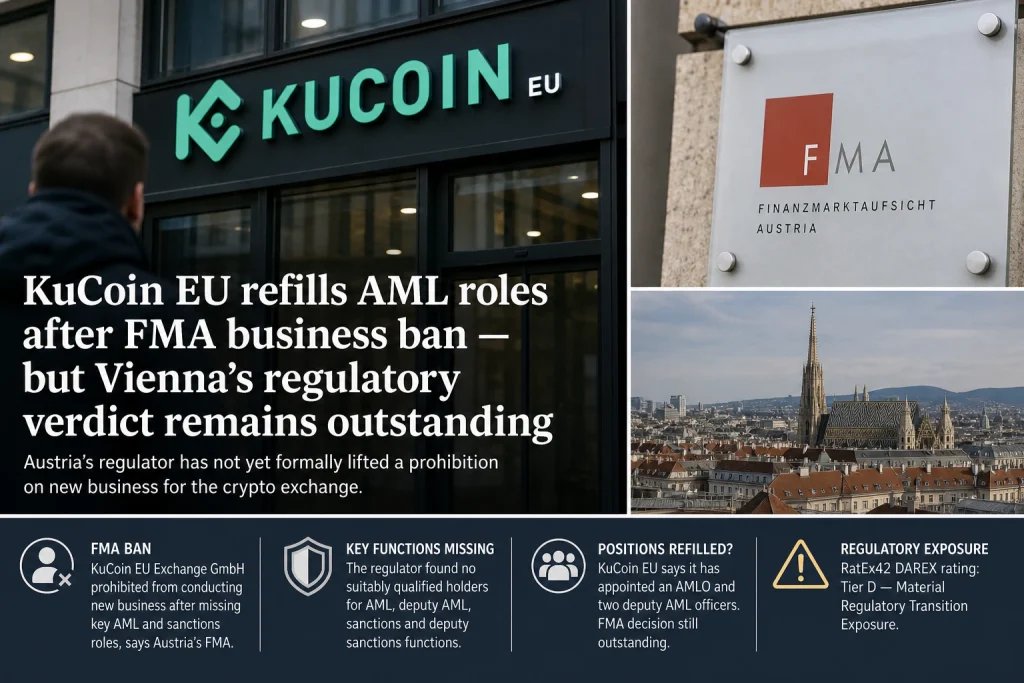
Austrian outlet Trending Topics reports that KuCoin EU has filled key AML positions and may soon return to normal operations. Scam-Or Project reads this differently: as a rehabilitation narrative that significantly underplays the real issue. Austria’s Financial Market Authority (FMA) formally prohibited KuCoin EU Exchange GmbH from conducting new business after discovering that critical AML and sanctions compliance functions were no longer properly staffed — and the FMA has not yet formally lifted that restriction.
Key Findings
- Trending Topics frames KuCoin’s situation as a temporary staffing issue, emphasising a possible return to normal operations.
- The FMA’s own statement is sharper: KuCoin EU Exchange GmbH was prohibited from new business because key AML, deputy AML, sanctions officer, and deputy sanctions roles were not suitably filled.
- Scam-Or Project previously reported that Oliver Stauber played a central role in KuCoin’s Austrian MiCA application and raised questions about whether Vienna was being used as a regulatory gateway for globally challenged crypto exchanges.
- KuCoin’s track record includes, plus previous regulatory warnings and AML-related concerns across multiple jurisdictions.
- RatEx42’s DAREX classification remains: KuCoin carries a Tier D — Material Regulatory Transition Exposure rating until the FMA position is materially resolved.
Compliance Repair or Narrative Management?
The Trending Topics article states that KuCoin EU has appointed Carmen Kleinhans as AMLO and two deputy AML officers — Klinger and Träxler, from Compliance Networks — presenting these as decisive steps toward restoring normal operations, suggesting formal prerequisites for lifting the new-business ban have been met. It acknowledges, however, that the FMA has not yet issued an official decision.
The harder regulatory reality: the FMA did not merely note a personnel reshuffle. It determined that KuCoin EU Exchange GmbH no longer had suitable key-function holders for AML, terrorist-financing prevention, and sanctions compliance — and therefore banned the company from entering new customer relationships or new contracts until legally compliant staffing is restored. That prohibition remains in place.
Scam-Or Project’s Assessment: Too Rosy, Too Convenient
The Trending Topics report emphasises “constructive dialogue,” “proactive suspension,” and “return to normal operations,” but gives insufficient weight to the structural question: how did a freshly MiCA-authorised CASP lose critical AML and sanctions functions so quickly after obtaining one of Europe’s most valuable crypto licences? Scam-Or Project previously highlighted the role of Austrian lawyer Oliver Stauber, who became a central figure in KuCoin’s Austrian MiCA setup — and questioned whether the licensing story reflected genuine regulatory rehabilitation or a sophisticated gateway strategy using Austria as an EU entry point.
Key Data
| Data Point | Details |
|---|---|
| Brand | KuCoin |
| EU Entity | KuCoin EU Exchange GmbH |
| MiCA Domain | kucoin.com/en-eu |
| Jurisdiction | Austria |
| Regulator | Austrian Financial Market Authority (FMA) |
| MiCA Status | CASP authorisation granted 27 November 2025 |
| FMA Measure | Prohibition on conducting new business |
| Reason for ban | Missing AML, deputy AML, sanctions officer, and deputy sanctions function holders |
| Current claim | Key compliance positions reportedly refilled |
| FMA decision | Official lifting of ban still outstanding |
| RatEx42 DAREX | Tier D — Material Regulatory Transition Exposure |
Why This Matters for Merchants and Investors
KuCoin’s case is a warning signal for the MiCA era. A licence is not a shield — it is a continuing obligation. For merchants, counterparties, and investors, the lesson is clear: regulatory status must be monitored dynamically. A provider may obtain a MiCA licence and still face operational restrictions if governance, AML, sanctions, or key-function requirements deteriorate after authorisation. That is precisely why RatEx42’s DAREX framework focuses on regulatory exposure and operational continuity risk, not marketing claims.
Conclusion
KuCoin’s new AML appointments may eventually satisfy the FMA. But until the Austrian regulator formally lifts the restriction, the situation remains unresolved. The Trending Topics story may serve KuCoin’s preferred narrative. Scam-Or Project’s position is more cautious: KuCoin’s Austrian MiCA story remains a stress test for Austria’s FMA, MiCA’s fit-and-proper standards, and the credibility of Europe’s new crypto licensing regime.
Share Information via Scam-Or Project Complaints
Scam-Or Project invites insiders, former employees, compliance officers, service providers, and counterparties with information about KuCoin EU, its AML remediation, Oliver Stauber’s role, or the FMA licensing process to submit information via Scam-Or Project Complaints.