
AI-Driven Restructuring In CyberFinance: How Coinbase And Fintech Giants Are Replacing Traditional Roles With Artificial Intelligence

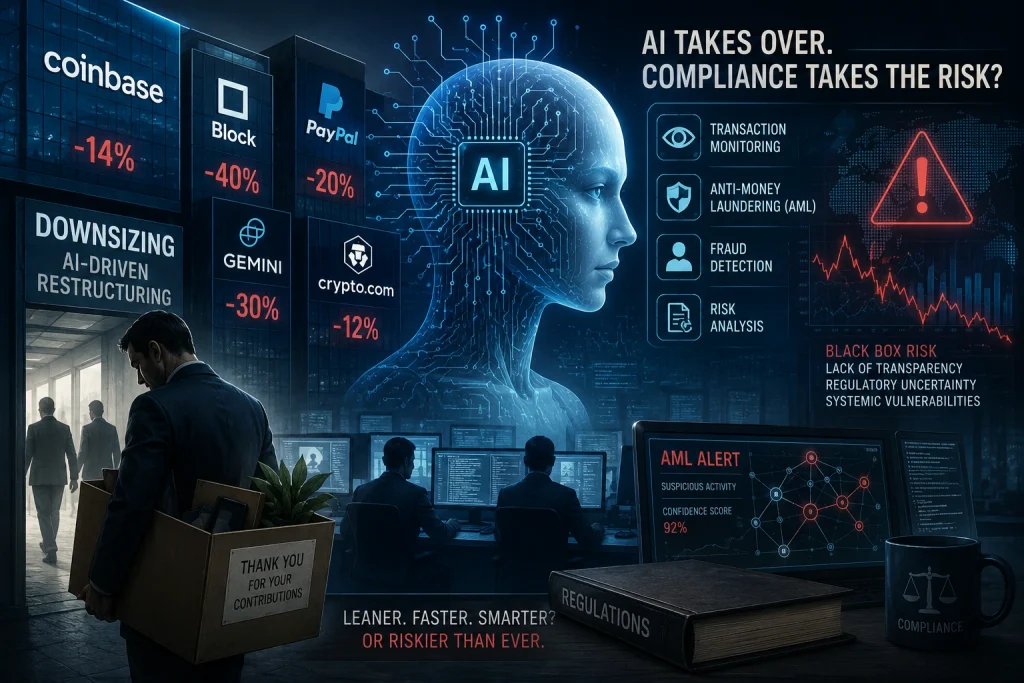
The cyberfinance and fintech sectors are entering a new operational era as companies aggressively restructure around artificial intelligence. The latest example comes from Coinbase, which recently reduced its workforce by 14% while accelerating its transition toward an AI-native business architecture.
This strategic transformation is spreading rapidly across crypto exchanges, payment companies, and fintech providers, fundamentally reshaping how businesses operate, manage employees, and handle regulatory compliance. At the same time, the growing reliance on AI systems is creating serious concerns around transparency, auditability, and systemic financial risks.
Key Findings
Major Workforce Reduction At Coinbase
- In May 2026, Coinbase eliminated roughly 700 positions, representing approximately 14% of its global workforce.
- The company announced a transition toward an “AI-driven operating model.”
- Internal development goals reportedly include reaching 50% AI-generated code production.
AI Downsizing Across The CyberFinance Sector
The restructuring trend extends well beyond Coinbase. Several major fintech and crypto firms have already introduced large-scale layoffs connected to AI integration:
| Company | Reported Workforce Reduction | AI Focus |
|---|---|---|
| Coinbase | 14% | AI-native operating model |
| Block | 40% | Replacing management layers with AI |
| PayPal | 20% planned reduction | AI support and automation systems |
| Gemini | 30% | Operational automation |
| Crypto.com | 12% | AI-driven efficiency measures |
| Algorand | 25% | Streamlined AI-supported operations |
Flattened Corporate Structures
Crypto and fintech firms are increasingly abandoning traditional corporate hierarchies:
- Coinbase is reportedly reducing management depth to only five layers below executive leadership.
- Companies are introducing small “AI-native teams” capable of handling product management, engineering, and design with minimal staffing.
- AI-enhanced employees are expected to perform work previously handled by entire departments.
Compliance Operations Are Being Automated
Artificial intelligence is now heavily integrated into:
- Anti-money laundering (AML)
- Fraud detection
- Transaction monitoring
- Customer verification procedures
- Risk analysis
Although automation significantly lowers operational costs, it simultaneously introduces new compliance and governance concerns.
The Shift Toward AI-Native Corporate Models
Coinbase’s Internal Transformation
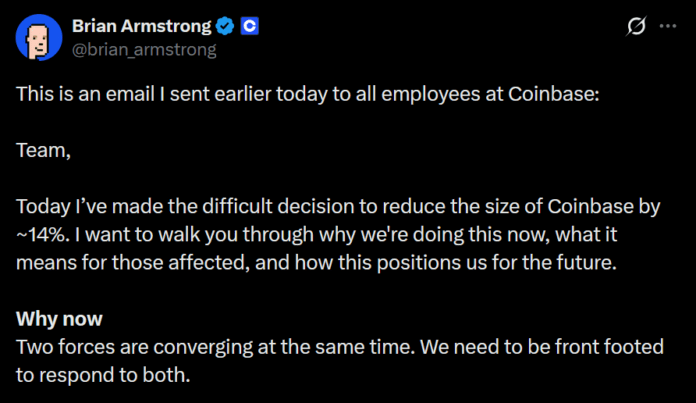
On May 5, 2026, Coinbase CEO Brian Armstrong stated publicly on X that artificial intelligence is fundamentally changing how companies operate and how employees perform work.
The layoffs at Coinbase represent more than a temporary cost-cutting exercise. The company appears to be redesigning its entire organizational structure around AI-assisted productivity.
According to internal communications referenced publicly by Armstrong:
- Coinbase is moving toward autonomous “AI-native pods”.
- Managers are expected to function as “player-coaches” rather than traditional supervisors.
- Employees are increasingly required to use AI tools such as GitHub Copilot and Cursor.
- Individual contributors augmented by AI systems are expected to deliver output previously requiring full teams.
This restructuring reflects a broader philosophy emerging in the cyberfinance sector: AI is no longer treated as an auxiliary tool, but as a direct replacement for significant portions of the workforce.
AI Restructuring Across CyberFinance And Fintech
Human Labor Increasingly Seen As Inefficient
The trend visible at Coinbase is now spreading throughout the wider fintech ecosystem.
Block
Block CEO Jack Dorsey announced earlier in 2026 that the company would reduce approximately 40% of its workforce. Public statements directly referenced AI capabilities replacing layers of middle management and operational support.
PayPal
PayPal has also signaled major workforce reductions over the next several years. The company is actively building AI-focused operational groups designed to automate:
- Customer support
- Fraud detection
- Internal operations
- Administrative processes
Crypto Exchanges
The digital asset industry has experienced similar restructuring:
- Gemini reportedly reduced staffing by 30%.
- Crypto.com reduced headcount by 12%.
- Algorand implemented workforce cuts of approximately 25%.
Across the sector, executives increasingly describe AI adoption as a critical efficiency measure rather than an optional innovation initiative.
Compliance Risks In AI-Driven Financial Systems
Automated AML And Fraud Detection
Artificial intelligence systems are now being heavily deployed for:
- Monitoring suspicious financial transactions
- Detecting behavioral anomalies
- Mapping transaction relationships
- Reducing false-positive compliance alerts
- Accelerating investigations into potential money laundering
Machine learning models and Large Language Models (LLMs) are capable of analyzing transaction networks at a scale impossible for human compliance teams.
This creates substantial operational advantages for crypto exchanges and payment institutions.
The “Black Box” Compliance Problem
Despite the efficiency gains, regulators face a major challenge: explainability.
Financial regulators require:
- Transparent audit trails
- Verifiable compliance logic
- Clear reasoning behind suspicious activity decisions
However, many AI systems operate as “black boxes,” meaning their internal decision-making processes are difficult or impossible to explain.
This creates significant risks when:
- Legitimate transactions are incorrectly blocked
- Criminal laundering schemes go undetected
- AI systems develop hidden biases
- Regulatory investigations require full decision transparency
Without strong Explainable AI (XAI) frameworks, cyberfinance firms may struggle to satisfy regulatory audit requirements.
Systemic Regulatory Vulnerabilities
A broader systemic issue is also emerging.
If multiple financial institutions rely on similar foundational AI models for compliance monitoring, identical weaknesses may spread across the industry simultaneously.
Potential consequences include:
- Shared blind spots across institutions
- Coordinated exploitation by cybercrime groups
- Large-scale AML detection failures
- Regulatory gaps affecting multiple markets at once
This introduces an entirely new category of systemic financial risk tied directly to AI standardization.
Conclusion
The AI-driven restructuring wave that accelerated in 2026 represents a permanent transformation within the cyberfinance industry.
Companies such as Coinbase, Block, and PayPal are rapidly proving that artificial intelligence is evolving from a productivity tool into a replacement for large portions of the workforce.
While this leaner operational model may improve margins and reduce overhead expenses, the growing delegation of critical compliance responsibilities to AI systems introduces substantial regulatory uncertainty.
The convergence of AI, fintech, and cyberfinance will likely require stronger oversight frameworks to ensure that automated compliance systems do not undermine the integrity and stability of global financial markets.
Call For Whistleblowers
Are you currently working at Coinbase, Block, PayPal, or another cyberfinance company implementing AI-driven restructuring?
Do you have information regarding:
- AI-based AML systems
- Automated KYC operations
- Internal compliance failures
- Algorithmic fraud-detection weaknesses
- Regulatory concerns tied to AI deployment
Scam-Or Project invites insiders to safely share information, internal documents, or compliance concerns through the Scam-Or Project Complaints. All submissions can be provided anonymously, and whistleblower identities will remain protected.