
FCA Investigation Into PayPal, Mastercard, and Visa Raises Questions About Digital Wallet Competition and Payment-Rail Control

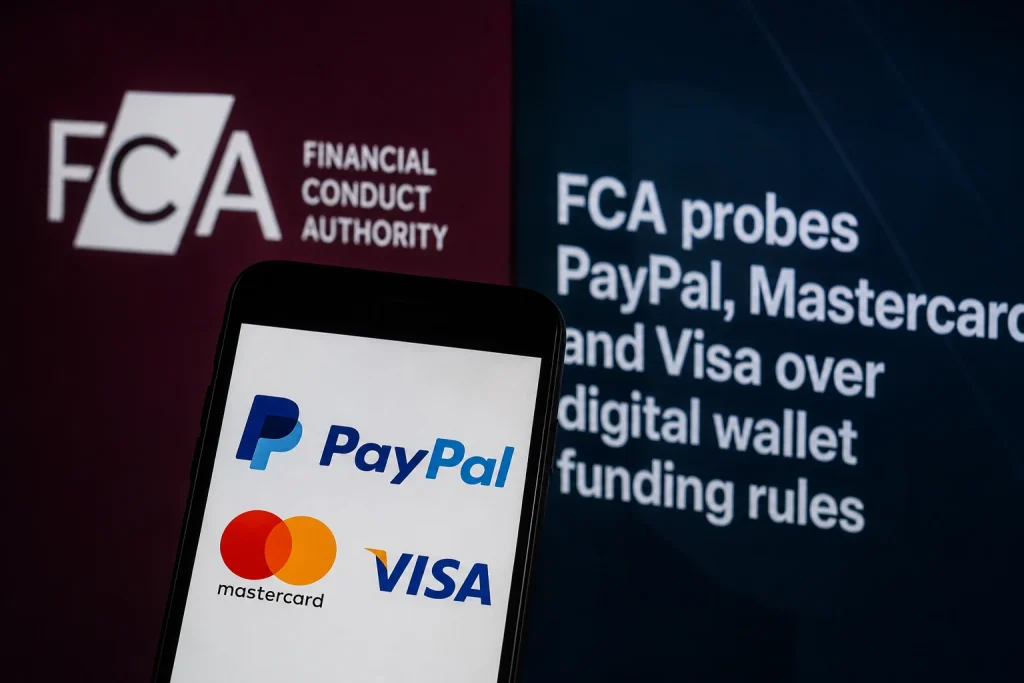
The UK Financial Conduct Authority (FCA) has launched investigations under the Competition Act 1998 into PayPal, Mastercard, and Visa over suspected anti-competitive conduct connected to the funding and operation of PayPal’s digital wallet ecosystem.
At this stage, the case is not related to AML failures, fraud allegations, or consumer-protection violations. The FCA has also made clear that it has not reached any conclusions or determined that any competition laws were breached. Instead, the investigation focuses on a broader structural issue: whether the contractual and economic framework behind one of the world’s largest digital wallets influences which payment rails consumers are encouraged to use.
According to the FCA, Mastercard, PayPal, and Visa are being investigated under Chapter I of the Competition Act 1998, while Mastercard and Visa are additionally under scrutiny under Chapter II. The regulator emphasized that the investigation remains at the evidence-gathering stage and may or may not lead to formal objections later.
For Scam-Or Project, the investigation highlights a deeper issue within modern payment infrastructure: the growing importance of digital wallets as strategic routing layers that influence how transactions are funded and processed.
Key Findings
FCA Opens Formal Competition Investigation
On 6 May 2026, the FCA confirmed that it had opened investigations into Mastercard, PayPal, and Visa concerning suspected anti-competitive behavior tied to the funding and use of PayPal’s digital wallet.
Separate Legal Frameworks Apply
The regulator is pursuing different legal theories under the Competition Act:
| Company | Chapter I Investigation | Chapter II Investigation |
|---|---|---|
| PayPal | Yes | No |
| Mastercard | Yes | Yes |
| Visa | Yes | Yes |
Chapter I addresses anti-competitive agreements, coordinated practices, or arrangements between companies. Chapter II concerns potential abuse of a dominant market position.
No Findings of Wrongdoing
The FCA explicitly stated that it has not concluded that any of the companies violated UK competition law. The investigation remains ongoing, and the regulator may ultimately decide not to proceed with formal allegations.
PayPal Revealed the Investigation First
The matter first became public through PayPal’s Q1 2026 Form 10-Q filing. In that disclosure, PayPal confirmed that it had received notices and information requests from the FCA in March 2026 regarding contractual provisions involving Visa and Mastercard linked to the funding and use of the PayPal wallet.
PayPal stated that it is cooperating fully with the investigation.
Historical Agreements Now Under Scrutiny
Publicly disclosed PayPal-Visa partnership terms dating back to 2016 are particularly relevant to the FCA’s review. Those arrangements reportedly included:
- Visa cards being displayed as prominent and equal payment options inside PayPal
- Users being able to designate Visa as a preferred funding method
- PayPal agreeing not to encourage Visa cardholders to connect bank accounts through ACH
- Economic incentives tied to higher Visa transaction volumes
- Long-term certainty regarding Visa fee structures
While these provisions are not evidence of illegal conduct, they illustrate why wallet-funding rules and interface design may now attract regulatory attention.
Digital Wallets Have Become Systemically Important
The FCA and the Payment Systems Regulator (PSR) previously reported that the share of UK card transactions conducted through digital wallets increased from 8% in 2019 to 29% in 2023.
This evolution transformed digital wallets from simple checkout tools into powerful infrastructure layers capable of influencing payment behavior across the retail economy.
Scam-Or Project Analysis: The Wallet Interface Controls the Rail
Consumers may see only a PayPal button during checkout. Regulators, however, see a sophisticated routing mechanism that determines which payment rails are prioritized.
That distinction is central to the FCA’s investigation.
Modern digital wallets are not passive front-end interfaces. They act as decision engines that influence:
- Which payment methods are displayed first
- Which funding sources are set as defaults
- Which options require fewer steps
- Which payment rails receive commercial preference
- Which economic incentives flow between schemes, banks, wallets, and merchants
In practical terms, the investigation may ultimately examine whether wallet architecture subtly favors scheme-card transactions over bank-account funding or emerging account-to-account alternatives.
Why the Chapter I and Chapter II Split Matters
The legal distinction in the FCA’s investigation is significant.
Chapter I: Contractual and Commercial Arrangements
Under Chapter I, the FCA is examining whether agreements or coordinated practices between the companies restricted competition within the UK payments market.
This includes questions such as:
- How PayPal’s agreements with Visa and Mastercard influenced wallet behavior
- Whether funding-method presentation was contractually shaped
- Whether alternative payment methods were disadvantaged
Chapter II: Dominant Market Position
The Chapter II investigation applies only to Mastercard and Visa and concerns potential abuse of dominant market positions.
Again, the FCA has not concluded that any abuse occurred. However, the investigation suggests regulators may be assessing whether the major card schemes used their market power to preserve card-rail dominance within digital-wallet ecosystems.
This gives the case broader significance beyond PayPal itself. The investigation potentially concerns the relationship between dominant wallet interfaces and dominant global card infrastructure.
The PayPal-Visa Partnership Model Under Regulatory Review
When PayPal and Visa announced their strategic partnership in 2016, the agreement was publicly framed as a consumer-friendly initiative intended to improve digital payments and expand choice.
The arrangement reportedly included:
| Reported Partnership Elements | Potential Competition Questions |
|---|---|
| Equal presentation of Visa cards in PayPal | Did presentation logic favor scheme-card funding? |
| Users could set Visa as preferred funding source | Were alternatives deprioritized? |
| PayPal would not encourage ACH bank linking for Visa users | Did this reduce bank-account competition? |
| Visa volume incentives for PayPal | Did economic rewards shape wallet behavior? |
| Fee-certainty arrangements | Did they reinforce scheme dependency? |
From a commercial perspective, the partnership made strategic sense for all sides involved.
PayPal benefited from stronger card-network cooperation, improved tokenization support, and broader acceptance. Visa and Mastercard reduced the risk that PayPal could evolve into a large-scale bank-account-funded alternative that bypassed traditional card rails.
From a competition-law perspective, however, regulators may now question whether these arrangements influenced consumer payment choices before the actual checkout decision even occurred.
The Economics Behind Wallet Funding
Funding sources inside digital wallets are not economically neutral.
Different payment rails generate different financial outcomes:
- Card-funded payments generate scheme fees, issuer revenues, and merchant acquiring costs
- Bank-account funding can bypass some card-network economics
- Stored wallet balances create additional value-capture layers
- Open-banking and account-to-account payments may reduce dependence on card schemes
The FCA’s concern therefore appears to center not on the existence of card payments themselves, but on whether commercial incentives and contractual terms influence how consumers are guided toward specific funding methods.
This concern aligns with earlier observations from the FCA and PSR, which warned that digital wallets could either support innovation and alternative payment systems — or reinforce the dominance of existing card networks.
Digital Wallets Are Becoming Payment-Rail Gatekeepers
The investigation fits into a broader global regulatory trend in which authorities increasingly examine the invisible infrastructure behind payment routing decisions.
Regulators are now paying closer attention to areas such as:
User Interface Design
- Which payment option appears first?
- Which method is preselected?
- Which option requires the fewest steps?
Commercial Incentives
- Are wallets receiving rebates or incentives tied to card volume?
- Do contractual arrangements favor specific rails?
Technical Dependencies
- Does contactless functionality rely on card-network infrastructure?
- Are tokenization systems controlled by dominant schemes?
Alternative Payment Suppression
- Are open-banking or account-to-account methods made less visible?
- Are non-card funding options commercially disadvantaged?
Market Power Concerns
- Are dominant card schemes preserving their volume dominance through wallet integrations?
This investigative framework closely resembles the payment-rail analysis frequently used by Scam-Or Project in investigations involving illegal gambling platforms, offshore brokers, and high-risk payment ecosystems.
The legal context differs, but the underlying logic remains the same: follow the payment rails, not merely the visible consumer-facing brand.
Company Responses
According to public statements cited in media coverage:
- Mastercard confirmed that it received an FCA information notice regarding its contractual relationship with PayPal
- Visa acknowledged an inquiry concerning contractual provisions tied to the PayPal wallet
- PayPal declined to provide additional comment because the investigation remains ongoing
All three companies stated that they are cooperating with the regulator.
These responses are standard in active competition investigations. The more important point is that the FCA’s inquiry is active, document-focused, and centered on contractual arrangements and wallet-funding architecture.
Compliance Note
The FCA has not concluded that PayPal, Mastercard, or Visa violated UK competition law. The investigation remains ongoing and is currently in the evidence-collection phase.
This report reflects Scam-Or Project’s analysis of:
- The FCA’s public announcement
- PayPal’s SEC disclosures
- Historic PayPal-Visa partnership materials
- Related UK payment-regulation developments
Whistleblower Request
Scam-Or Project invites payment-industry insiders, PSP employees, merchants, open-banking providers, former PayPal personnel, and card-scheme professionals to provide information concerning:
- Digital-wallet funding arrangements
- Default payment configurations
- Rail-prioritization mechanisms
- Wallet-interface steering
- Merchant-pricing structures
- Volume-incentive agreements
- Alternative-payment suppression practices
Relevant documents, screenshots, contractual materials, and technical insights can be submitted securely through the Scam-Or Project Complaints.