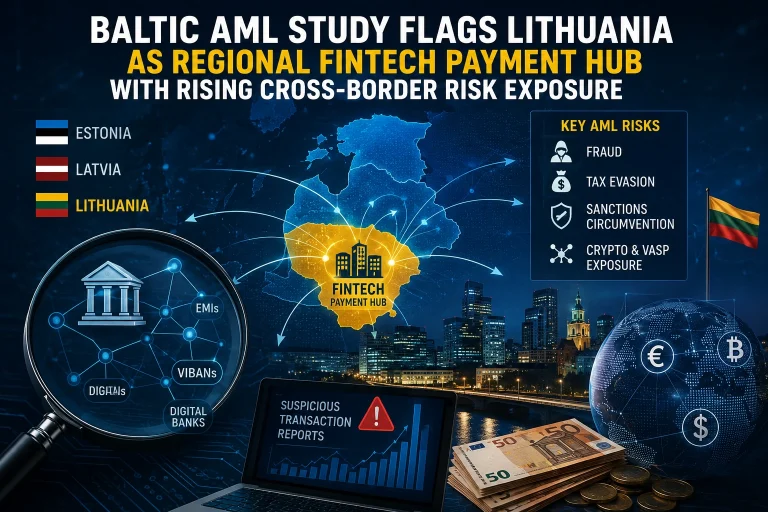

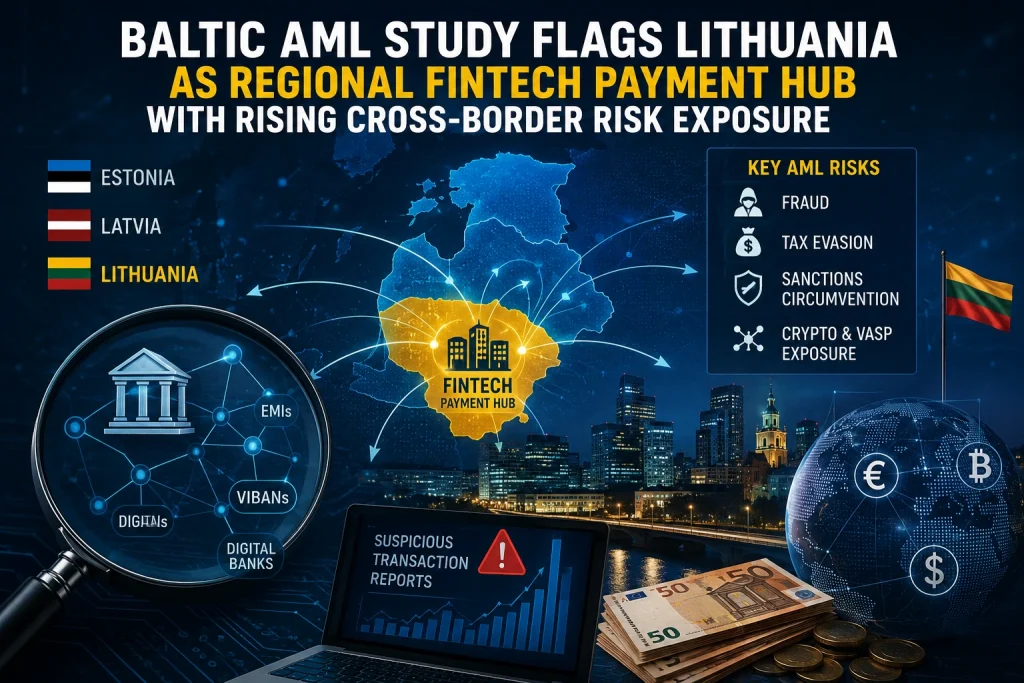
Baltic AML Study Warns Of Lithuania’s Expanding Role As A High-Risk FinTech Payment Hub

Baltic FIUs Release Major AML Report On Digital Payment Infrastructure
The Financial Intelligence Units of Estonia, Latvia, and Lithuania, supported by the Bank of Lithuania, have issued a comprehensive regional report titled “Evolving Payment Landscapes and AML Challenges in the Baltic States.” The analysis covers developments between 2021 and the first half of 2024 and examines payment institutions, e-money institutions, credit institutions, cross-border payment activity, suspicious transaction reporting, and emerging money-laundering schemes throughout the Baltic region.
For Scam-Or Project, the report represents a significant confirmation of patterns repeatedly identified in investigations involving offshore gambling payments, investment fraud infrastructures, crypto on-ramp systems, and open-banking transaction flows.
The study makes one point increasingly clear: modern AML risks are no longer concentrated within traditional banking systems alone. They now emerge through the interaction of digital banks, EMIs, payment institutions, VIBAN frameworks, embedded-finance platforms, crypto intermediaries, and cross-border account structures.
Rather than reading like a theoretical compliance document, the report resembles an institutional acknowledgment of how modern payment rails actually operate.
Key Structural Findings Across The Baltic States
According to the FIUs, Estonia and Latvia continue to operate primarily bank-centered financial systems with largely domestic client bases. Lithuania, however, has evolved into a major regional FinTech and payment-services center with significantly higher exposure to foreign customers and international transactions.
The report explains that Lithuania’s rapid growth in digital banking, EMIs, and payment institutions has strengthened its integration into the EU financial ecosystem while simultaneously increasing exposure to money-laundering and terrorist-financing risks linked to:
- remote onboarding,
- cross-border financial activity,
- non-face-to-face service models,
- complex payment chains,
- and high-risk industries.
The FIUs further conclude that Estonia and Latvia reduced some risks tied to non-resident banking through stricter AML controls and de-risking measures. However, the study suggests that these risks did not disappear — they shifted toward Lithuanian payment-service providers and alternative digital-finance platforms.
One particularly notable finding is that Lithuanian FinTech payment accounts appear frequently in suspicious transaction reports submitted by Estonian and Latvian authorities. The study identifies fraud, tax evasion, and sanctions circumvention as dominant regional AML threats, often involving digital banks, EMIs, and VASPs.
The FIUs also highlight recurring obstacles in tracing illicit funds, including:
| AML Obstacle | Description |
|---|---|
| Transit accounts | Used to rapidly move funds across jurisdictions |
| Shell companies | Obscure beneficial ownership |
| Strawmen | Nominal account holders masking real operators |
| VIBAN structures | Complicate transparency and transaction tracing |
Lithuania’s Success As A FinTech Hub Also Increased Regional AML Pressure
The report acknowledges that Lithuania successfully positioned itself as one of Europe’s leading FinTech jurisdictions. The country now hosts a significantly larger PI/EMI sector than Estonia or Latvia.
However, the FIUs warn that the same factors driving growth also amplify compliance risks. Lithuanian-regulated payment providers process substantial transaction volumes for non-domestic clients, particularly through:
- international payment flows,
- pass-through transactions,
- non-resident portfolios,
- remote onboarding models,
- and high-risk commercial sectors.
The study specifically notes that in 2024, clients from Estonia and Latvia overwhelmingly relied on a single Lithuanian digital bank for both transaction volume and customer activity. While the institution is not identified, the concentration itself is considered significant from both supervisory and investigative perspectives.
This observation aligns closely with multiple Scam-Or Project investigations that identified Lithuanian-linked EMIs, digital banks, and payment intermediaries in transaction chains associated with:
- offshore gambling,
- crypto payment onboarding,
- cross-border investment schemes,
- and high-risk merchant structures.
The report does not criticize Lithuania’s FinTech strategy directly. Instead, it warns about the structural AML pressure created by rapid digital-finance expansion.
Estonia: BaaS Models, VIBAN Structures, And Crypto Exposure
The FIUs also outline several Estonia-specific vulnerabilities. Although the Estonian market remains largely bank-dominated, authorities identify growing risks connected to Banking-as-a-Service models and correspondent-style relationships involving foreign crypto and FinTech platforms.
The study explains that suspicious funds are frequently routed through the Estonian financial system using VIBAN structures capable of obscuring:
- the beneficial owner,
- the origin of funds,
- and the real economic purpose of transactions.
The transaction volumes referenced in the report are substantial:
| Year | Cross-Border Payment Volume |
|---|---|
| 2021 | €105 billion |
| 2024 | €136 billion |
Additional figures cited include:
- €84 billion in PI/EMI respondent payments during 2024,
- €33.5 billion linked to VASP-related activity,
- approximately 89% of cross-border payment volume connected to non-resident respondents from the EEA and United Kingdom.
These findings strongly mirror Scam-Or Project investigations into opaque payment chokepoints and layered financial infrastructures.
The core concern is no longer whether a financial institution is licensed. The more important question is whether its business model creates opaque transaction rails for third-party operators, offshore merchants, crypto platforms, or high-risk digital ecosystems.
VIBANs, Embedded Finance, And The Growing Transparency Problem
The study dedicates considerable attention to VIBAN systems, open-banking structures, embedded finance, and Banking-as-a-Service frameworks.
Latvia’s National Risk Assessment reportedly identifies VIBANs and open-banking systems as emerging threats because of:
- sub-account opacity,
- fragmented compliance responsibilities,
- unclear transaction-monitoring accountability,
- and difficulties encountered by FIUs or law enforcement when requesting information or freezing assets across jurisdictions.
Estonia’s NRA similarly warns about VIBAN services offered to financial intermediaries without sufficiently assessing underlying client risks. Authorities also express concern regarding bundled transaction files that may prevent accurate customer profiling.
These observations correspond directly with issues repeatedly identified in Scam-Or Project investigations into casino payment rails and investment-scam infrastructures.
In many cases, the payment chain becomes fragmented:
- the consumer sees one interface,
- the bank sees a different counterparty,
- the real merchant sits behind several gateways,
- and the economic purpose becomes diluted or obscured.
Scam-Or Project has previously described this phenomenon as payment-purpose dilution — a situation where multiple gateways, processors, VIBAN layers, crypto ramps, and offshore intermediaries make it increasingly difficult to determine the actual purpose of a transaction.
Fraud, Tax Evasion, And Sanctions Circumvention Remain Dominant Threats
The Baltic FIUs identify three primary predicate offences throughout the region:
- fraud,
- tax evasion,
- sanctions circumvention.
According to the report, payment systems across Estonia, Latvia, and Lithuania are frequently used during the layering stage of money-laundering operations. These flows often involve digital banks, EMIs, and VASPs.
The study also records rising suspicious-transaction reporting tied to Lithuanian-linked financial activity.
Latvia
- STRs referencing Lithuania increased between 2022 and 2024.
Estonia
- STRs connected to Lithuanian accounts rose significantly.
- Lithuanian accounts used by Estonian individuals and companies represented a substantial share of Estonian foreign-account STRs.
The report additionally highlights increased crypto exposure within Lithuanian-linked payment flows.
| Category | Share Of STRs Involving Crypto |
|---|---|
| Estonian payment-account STRs (average) | ~7% |
| Estonia in 2024 | ~12% |
| Lithuanian-linked payment-account STRs | ~18% |
Scam-Or Project Analysis: The Baltic States As Europe’s Payment-Rail Test Zone
The Baltic region increasingly resembles a laboratory for the future of European AML supervision.
The combination of:
- advanced FinTech ecosystems,
- EU passporting,
- Nordic banking integration,
- crypto exposure,
- and extensive cross-border activity
creates both innovation and vulnerability.
The official study effectively validates several long-standing Scam-Or Project working conclusions.
1. De-risking Relocates Risk
When traditional banks off-board clients, those customers frequently migrate toward digital banks, EMIs, payment institutions, VIBAN providers, or crypto-friendly intermediaries.
2. Licensing Does Not Automatically Create Transparency
A licensed EMI or digital bank may still facilitate opaque or high-risk payment flows if it relies on poorly monitored third-party structures.
3. Crypto Risks Increasingly Enter Through Payment Rails
AML exposure now often emerges through the interaction between bank accounts, EMIs, VASPs, VIBANs, and on/off-ramp infrastructures rather than through exchanges alone.
4. Cross-Border Risks Require Cross-Border Supervision
National supervision becomes structurally insufficient when clients, beneficial owners, PSPs, VASPs, merchants, and victims are spread across multiple jurisdictions.
Why The Study Matters For Offshore Casino Payment Investigations
Although the report is not specifically focused on illegal online casinos, its findings directly relate to ongoing investigations into offshore gambling payment infrastructures.
Many illegal casino ecosystems rely on exactly the structures highlighted by the FIUs:
- cross-border payment intermediaries,
- non-transparent payees,
- VIBAN account frameworks,
- crypto onboarding rails,
- open-banking flows,
- and payment-purpose dilution.
As a result, the player may believe they are funding a casino account, while the banking layer only sees a payment processor, gateway, wallet service, or unrelated commercial descriptor.
The Baltic FIU study therefore provides an important institutional AML framework for understanding why these payment rails deserve closer scrutiny.
They are not merely technical infrastructure.
They may function as financial-crime infrastructure.
Regulatory Takeaways From The FIU Study
The Baltic FIUs recommend several regional measures, including:
- stronger harmonisation of supervisory data,
- enhanced staff training,
- sector-specific AML typology studies,
- improved dissemination of red flags,
- and unified indicators for PSP-related suspicious transaction reports.
Scam-Or Project would extend the discussion further.
European regulators should increasingly treat payment-rail opacity itself as a standalone compliance risk. Where the:
- merchant,
- payment descriptor,
- gateway,
- account holder,
- beneficial operator,
- and economic purpose
do not clearly align, enhanced due diligence should become mandatory.
The essential question is no longer simply:
“Is the PSP licensed?”
The more relevant question is:
“What type of payment rail is the PSP enabling — and for whom?”
Conclusion
The Baltic FIUs have produced one of the most relevant regional AML studies in recent years. The report demonstrates that AML risks in the Baltic States have evolved into a more technologically complex environment characterized by:
- fewer traditional non-resident banking scandals,
- more digital payment rails,
- greater FinTech concentration,
- higher VIBAN opacity,
- stronger crypto adjacency,
- and faster cross-border movement of funds.
For Scam-Or Project, the study strongly reinforces the importance of following payment rails from:
- the customer interface,
- to the gateway,
- to the PSP,
- to the VIBAN or correspondent layer,
- and ultimately toward offshore structures, crypto ecosystems, or settlement networks.
The Baltic States are no longer merely a regional AML case study.
They increasingly represent a preview of Europe’s future payment-risk environment.