
Aku.africa Under Review: Licensed Nigerian Payment Rail or Alleged “Visa Penalty Letter” Scheme?

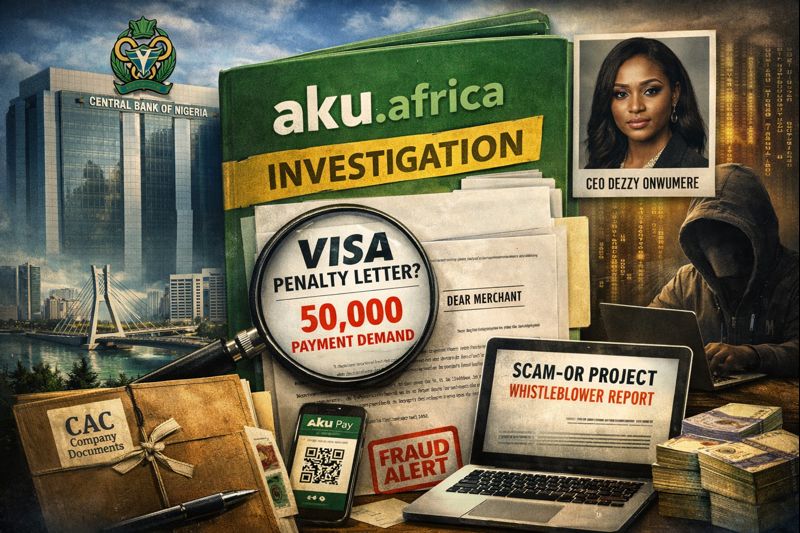
Scam-Or Project has received an unverified whistleblower tip alleging that Aku (aku.africa) may be issuing falsified “Visa penalty letters” to pressure merchants into paying substantial “penalties.” At this stage, the claim cannot be confirmed or disproven. What can be done now is to document Aku’s publicly available footprint—its corporate representations, products, and Nigeria’s regulatory framework—and invite insiders and affected parties to help close the evidentiary gaps.
Key Facts at a Glance
-
Brand / Operator (website disclosures):
“© Akupay Services Limited” and “Aku is a trademark of Aku Fintech Services Ltd (Lagos),” with an address listed in Lekki, Lagos. -
Regulatory Footprint:
The Central Bank of Nigeria (CBN) lists Akupay Services Limited as authorised under the Payment Solution Service Provider (PSSP) category. -
Market Positioning:
Aku promotes a mix of “payments + simple banking,” including Aku Pay Cards, QR-based acceptance, and the promise of “turning every phone into a POS.” -
Founders / Executives (open-source references):
Multiple public sources name Adaeze “Dezzy” Onwumere (Ogakwu) as CEO and co-founder, with Patrick Onwumere referenced as co-founder. -
Directors / Ownership (not independently verified):
A third-party Nigerian company-information platform lists Patrick Onwumere and Adaeze Mabel Ogakwu as directors and indicates shareholder data. This should be treated as a lead only until confirmed via official Corporate Affairs Commission (CAC) filings.
Regulatory and Compliance Context
What a CBN PSSP Licence Means
A PSSP authorisation from the CBN signals a regulated payments-service role. It does not equate to a deposit-taking “bank” licence. When fintechs market themselves as “digital banks,” key compliance questions include:
- Which regulated entity actually holds customer funds?
- Who provides settlement or safeguarding accounts?
- Are services such as credit or wealth products delivered directly, or via licensed partner institutions?
Baseline Obligations in Nigeria
CBN-regulated payment providers are expected to:
- Implement AML/CFT controls in line with Nigerian law and CBN AML/CFT/CPF rules.
- Comply with Nigeria’s data protection regime and consumer protection standards.
- Maintain transparent relationships with acquiring banks and card-program partners.
Whistleblower Allegation (Unverified)
The whistleblower alleges that:
- Aku submits fabricated “Visa penalty letters” that lack a verifiable case ID.
- Aku’s API requires merchants to provide a “source URL.”
- That URL is allegedly referenced in a subsequent “penalty letter,” followed by a demand for payment in the range of “50k–60k” (currency unspecified).
No primary documents have been reviewed so far. If authentic, merchants should verify any claimed “scheme penalty” directly with their acquiring bank or card-program partner—not rely solely on an intermediary’s letter.
How Legitimate “Penalty Letters” Usually Work
In card payments, a “penalty letter” typically reflects a notice originating upstream—from a card scheme via an acquiring bank—when a merchant breaches network rules. Common triggers include:
- Excessive chargeback or dispute ratios
- Elevated fraud levels
- Prohibited business models
- Material compliance failures
In legitimate cases, penalties are not arbitrary invoices. They are supported by:
- A specific case or reference ID
- Identified program or rule set
- Clear dates, metrics, and thresholds
- Verifiable contacts at the acquirer or scheme
- Settlement through the established acquiring relationship
Compliance Risk Highlighted by the Allegation
If a processor or intermediary were to fabricate penalty notices—especially without verifiable upstream documentation—the “penalty” would function as a pretext to extract funds from merchants. Such conduct would plausibly constitute misrepresentation or fraud and could amount to unjust enrichment, as payments would not be linked to a genuine scheme or acquirer assessment.
Call for Information
Scam-Or Project whistleblower section
Do you possess contracts, invoices, alleged “penalty letters,” email correspondence, screenshots of the “source URL” API field, settlement-account details, acquiring-partner information, or CAC filings related to Aku, Akupay Services Limited, or Aku Fintech Services Ltd?
Affected merchants, insiders, and regulators are invited to submit evidence—securely and, if necessary, anonymously—via the Scam-Or Project whistleblower section. Additional documentation will help verify or refute the allegation and clarify whether Aku’s practices align with Nigeria’s regulatory perimeter.