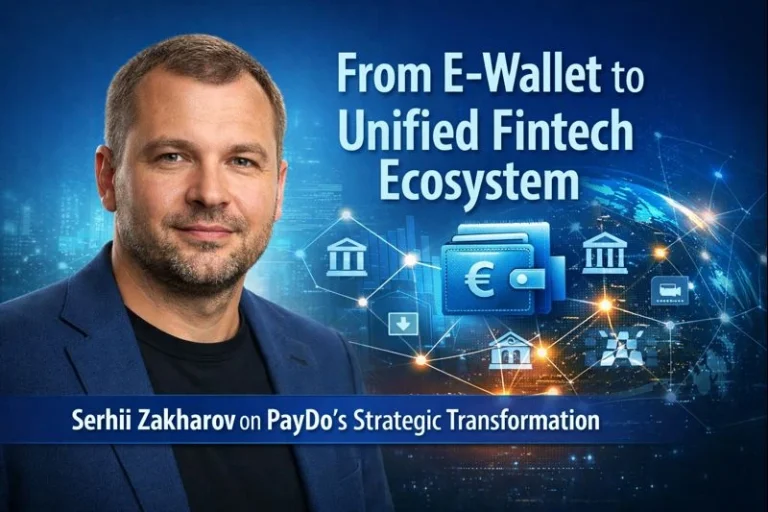

An Architect’s Vision: Why Serhii Zakharov Believes an Ecosystem Is the Inevitable Endgame of Fintech

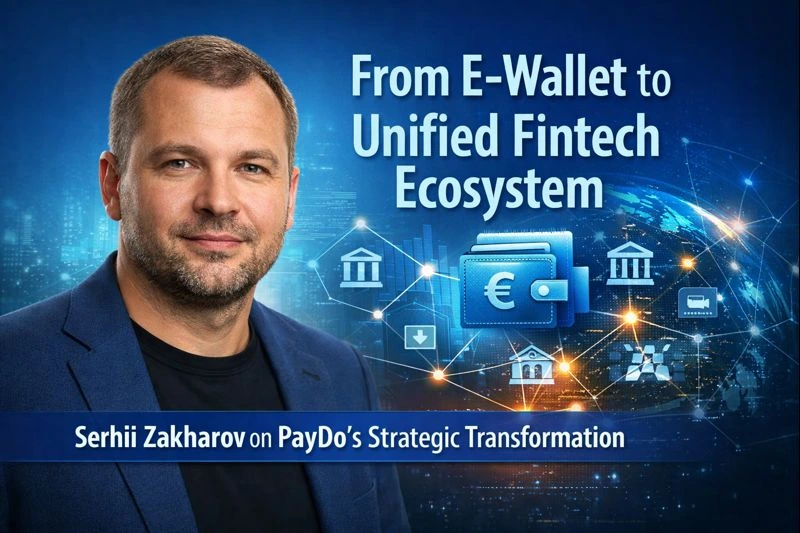
PayDo’s Founder on the Strategic Evolution from a Standalone E-Wallet to a Unified Financial Platform
In a fintech landscape crowded with isolated tools and short-lived innovations, PayDo has deliberately chosen a different trajectory. Instead of reacting to every emerging payment trend, the company—led by founder Serhii Zakharov—has focused on consolidation, vertical integration, and long-term infrastructure thinking.
After PayDo’s public announcement earlier this year outlining its transition toward a unified financial ecosystem, Zakharov spoke with Scam-Or Project about the rationale behind this strategy, the lessons learned since the launch of the non-redirect e-wallet in 2021, and why fragmentation has become the industry’s most costly structural flaw.
From a Breakthrough Wallet to a Broader System
Scam-Or Project:
In 2021, PayDo gained attention for its non-redirect e-wallet. Today, the conversation has shifted to building a full “financial ecosystem.” What prompted this evolution?
Serhii Zakharov:
The wallet addressed a very specific and urgent pain point—the broken checkout flow. From a technical standpoint, it worked exactly as intended and proved itself as a strong point solution. However, as clients began using it at scale in 2022—particularly in e-commerce, SaaS, and iGaming—we started hearing the same story repeatedly.
Fixing one bottleneck did not resolve the wider operational chaos. Merchants were still juggling multiple providers for banking, payouts, foreign exchange, and compliance. The wallet treated the symptom, not the underlying condition. The real issue was systemic fragmentation. Building an ecosystem was not a pivot away from our original idea; it was a logical continuation—following the problem to its source.
Beyond Bundling: Engineering True Interoperability
Scam-Or Project:
Is this ecosystem simply a bundle of existing PayDo products such as wallets, business accounts, and payout solutions?
Zakharov:
No. Bundling is superficial—it’s packaging. What we are building is functional integration at the infrastructure level. A useful analogy is the difference between carrying separate devices and using a smartphone. When everything operates within a single system, each component reinforces the others.
Our partnership with Fidor Bank in 2021 was never about resale. It was about establishing dependable banking rails. The current ecosystem work ensures that funds received via the wallet are instantly reflected in the ledger, cleared through compliance, and available for SEPA payouts—all within one unified data structure. One ledger. One compliance layer. One operational logic. That cohesion is what delivers real efficiency.
The Hidden Cost of Fragmentation
Scam-Or Project:
You often refer to a “fragmentation tax.” How does this translate into concrete business costs?
Zakharov:
We see it clearly in day-to-day operations. As companies grow, their finance teams can spend 20–30% of their time manually reconciling data between disconnected systems. That’s pure overhead. On top of that, businesses often lose an additional 2–4% through accumulated fees and unfavorable FX rates spread across multiple providers.
But the most damaging cost is strategic inertia. When financial data lives in silos, leadership lacks real-time visibility into cash positions. Treasury automation becomes impossible. Decision-making slows down. Instead of scaling the business, teams are forced to manage infrastructure. The ecosystem approach removes that burden and turns finance into a predictable, controlled utility rather than a constant operational drain.
Early Signals from the Market
Scam-Or Project:
What kind of feedback have you received since outlining this ecosystem strategy?
Zakharov:
The strongest validation comes from long-term clients. Many of those who initially adopted the wallet are now consolidating additional financial workflows within PayDo. They experience the contrast firsthand.
What they report goes beyond improved KPIs. Their teams regain time and focus. Instead of acting as human connectors between incompatible systems, finance departments can concentrate on analysis, forecasting, and strategic planning. That transition—from operational firefighting to intentional financial management—is the clearest indicator that we are addressing the right structural problem.
The End Goal: Invisible Infrastructure
Scam-Or Project:
What is the long-term objective of the PayDo ecosystem?
Zakharov:
The ideal infrastructure is invisible. When it works perfectly, nobody notices it. Our ambition is to deliver a financial operating layer that founders can rely on without thinking about it. Payments, banking, payouts, and cash flow should function as a single intelligent system in the background.
From the non-redirect wallet that marked the beginning of this journey to the unified platform we are now building, every step is driven by the same principle: remove complexity so entrepreneurs can focus entirely on their product, their customers, and their growth.
Share Information
If you have information related to PayDo or other high-risk payment processors and their activities, please contact us via the Scam-Or Project whistleblower section.