
PayDo’s Strategic Shift: From Standalone Products to an Integrated Financial Ecosystem

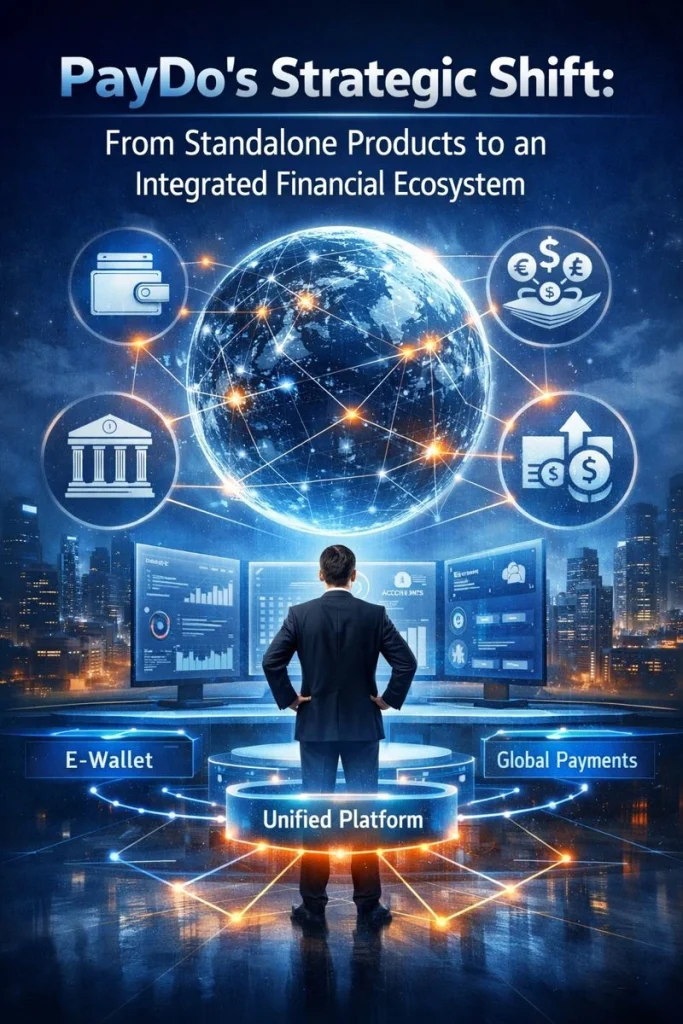
CEO Serhii Zakharov Outlines a Plan to Unite the Fragmented Fintech Infrastructure for Online Businesses
PayDo, a digital financial services platform, has publicly outlined a notable shift in its long-term strategy. Previously recognized for individual fintech solutions such as its non-redirect e-wallet, the company is now repositioning itself as a provider of a fully integrated financial ecosystem. This strategic transition, led by founder and CEO Serhii Zakharov, is designed to tackle the growing inefficiencies and operational complexity that online businesses face as they scale.
Rather than offering isolated tools, PayDo is aiming to consolidate core financial operations into a single, cohesive framework that simplifies payments, treasury management, and payouts.
Key Company Information
| Category | Details |
|---|---|
| Trading name | PayDo |
| Business activities | FCA-regulated e-Money Institution; Merchant service provider |
| Domain | https://paydo.com |
| Social media | LinkedIn, Twitter, Facebook |
| Legal entity | Ecommerce Technologies Ltd |
| Jurisdictions | United Kingdom, Ukraine |
| Authorization | FCA, reference no. 900916 |
| Related individuals | Serhii Zakharov (LinkedIn) |
| Oleg Pikarevskyi (LinkedIn) | |
| Matvii Mikhnevych (LinkedIn) | |
| Ivan Pronchenkov (LinkedIn) |
Strategic Direction: From Individual Solutions to a Unified Layer
The announcement formalizes a trajectory that has been taking shape since PayDo launched its e-wallet in 2021 and expanded its capabilities through a partnership with Germany’s Fidor Bank in 2022. While those initiatives addressed specific challenges—such as improving checkout conversion rates and accessing European payment infrastructure—the current strategy aims to bring all services together under a single operational layer.
PayDo’s leadership presents this move as a response to a broader industry issue: the over-fragmentation of fintech tools used by online merchants. The company positions itself as an emerging all-in-one financial partner for digital businesses seeking efficiency and scalability.
Executive Commentary
“The fintech landscape is full of strong point solutions, but that strength has created a new burden for businesses—complex integrations and rising operational costs,” said Serhii Zakharov, CEO of PayDo. “Our work with the e-wallet and our banking partners made it clear that the next phase of value lies in simplification, not in adding more isolated features. Our focus now is on building the connective infrastructure that turns PayDo into a centralized control hub for business finance.”
The Foundation of PayDo’s Expanding Ecosystem
Industry observers point out that PayDo’s ecosystem strategy is grounded in existing, operational components rather than speculative development. The platform is assembling a unified system from modules that have already demonstrated market viability.
Core Components Include:
-
Non-Redirect E-Wallet
The primary customer-facing solution, designed to streamline checkout flows and enable instant funding. -
Multi-Currency Business Accounts
Centralized accounts for holding, managing, and allocating funds across multiple currencies. -
Global Payout Infrastructure
Built on partnerships that support mass payments via SEPA, SWIFT, and various local transfer systems. -
Unified API and Dashboard
A technical and operational layer that connects all services into a single access point for merchants.
Analyst Perspective and Roadmap Focus
“This evolution reflects a natural next step,” noted a fintech analyst familiar with PayDo’s development. “The company has already proven demand for its individual products. The strategic opportunity now is to deepen client engagement by minimizing dependency on external providers. Their cross-sector traction since 2022 created a solid foundation for this move.”
Serhii Zakharov confirmed that PayDo’s near-term roadmap is centered on strengthening both technical and commercial integration between these components. The goal is to enable businesses to oversee payments, cash flow, and payouts through a more synchronized and efficient interface.