
Behind the Innovation: PayDo’s Blueprint for Solving Checkout Payment Friction

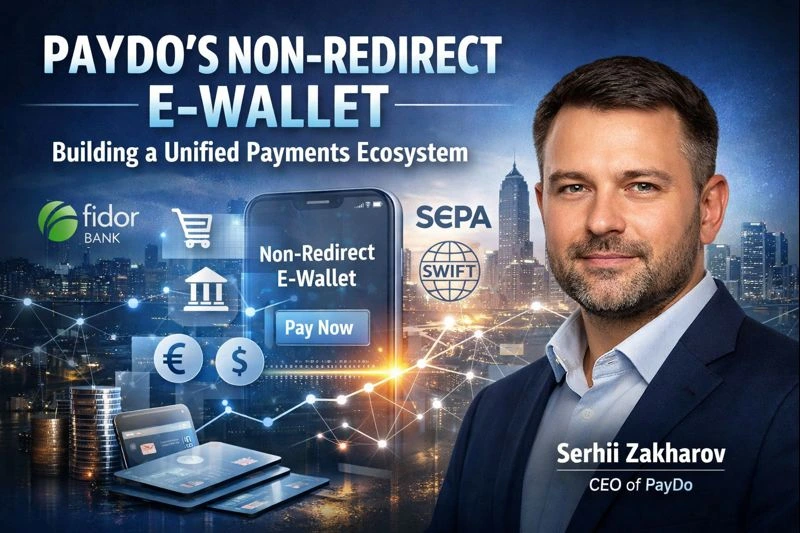
CEO Serhii Zakharov on the Non-Redirect E-Wallet and the Road to a Unified Payments Ecosystem
In a fintech market obsessed with isolated “killer features,” PayDo is pursuing a different playbook—one centered on consolidation, continuity, and removing friction at every step of the payment journey. In a focused conversation, CEO Serhii Zakharov unpacked the company’s flagship innovation, the Non-Redirect E-Wallet, and outlined a longer-term strategy to build a single, integrated payments ecosystem for online businesses.
The Origin of the Non-Redirect E-Wallet
“Our starting observation was simple but critical,” Zakharov noted. “Each redirect during checkout creates hesitation, increases drop-off, and chips away at trust. We asked ourselves: what if the entire payment experience stayed in one place?”
That question became the foundation for PayDo’s first major product milestone—the Non-Redirect E-Wallet. Rolled out in mid-2021, it was designed not merely as another payment option, but as a conversion-focused instrument for merchants. By keeping customers on the merchant’s site throughout the transaction, the wallet reduces abandonment and delivers a smoother, more controlled user experience. This targeted solution to a high-impact problem reflects PayDo’s pragmatic approach to innovation.
Partnerships as Infrastructure, Not Marketing
Zakharov stressed that progress in payments depends on strong institutional foundations. A key example is PayDo’s partnership with Fidor Bank.
“To operate reliably, quickly, and competitively across Germany and the wider Europe, you need direct access to solid banking rails,” he explained. “Working with Fidor is not a badge—it’s a structural step toward building direct connections like SEPA and SWIFT that will underpin our future platform.”
This collaboration strengthens PayDo’s European processing capabilities and reinforces the practical value of the e-wallet and related services.
From Single Feature to Unified Ecosystem
When discussing PayDo’s broader direction, Zakharov highlighted a persistent pain point for digital merchants: fragmentation.
“Most businesses juggle multiple providers—one for banking, another for acquiring, others for payouts and compliance. That complexity slows growth,” he said. PayDo’s answer is to evolve from point solutions into a comprehensive platform.
The company is actively pursuing direct memberships with major payment schemes, aiming to centralize essential financial operations under one roof.
What the unified ecosystem is designed to deliver:
| Capability | Description |
|---|---|
| Multi-currency accounts | Hold and manage funds across currencies |
| On-site payments | Accept payments via the Non-Redirect E-Wallet |
| Payouts | Execute mass and individual payouts efficiently |
| Single integration | One contract, one technical connection |
| Reduced complexity | Fewer vendors, clearer operations |
“Imagine running all financial services—holding funds, accepting payments, and distributing payouts—through one agreement and one integration,” Zakharov said. “That’s how we remove operational drag and become a genuine growth partner.”
What’s Next
With the Non-Redirect E-Wallet setting a higher bar for checkout UX and strategic partnerships reinforcing its European backbone, PayDo is positioning itself as more than a typical fintech provider. The company’s focus for the coming phase is scaling its ecosystem model—bringing increasingly unified solutions to market so merchants can concentrate on growth instead of payment logistics.