
Austria Once Again Blocks Firtash Extradition – Vienna’s Oligarch Problem Resurfaces

Overview
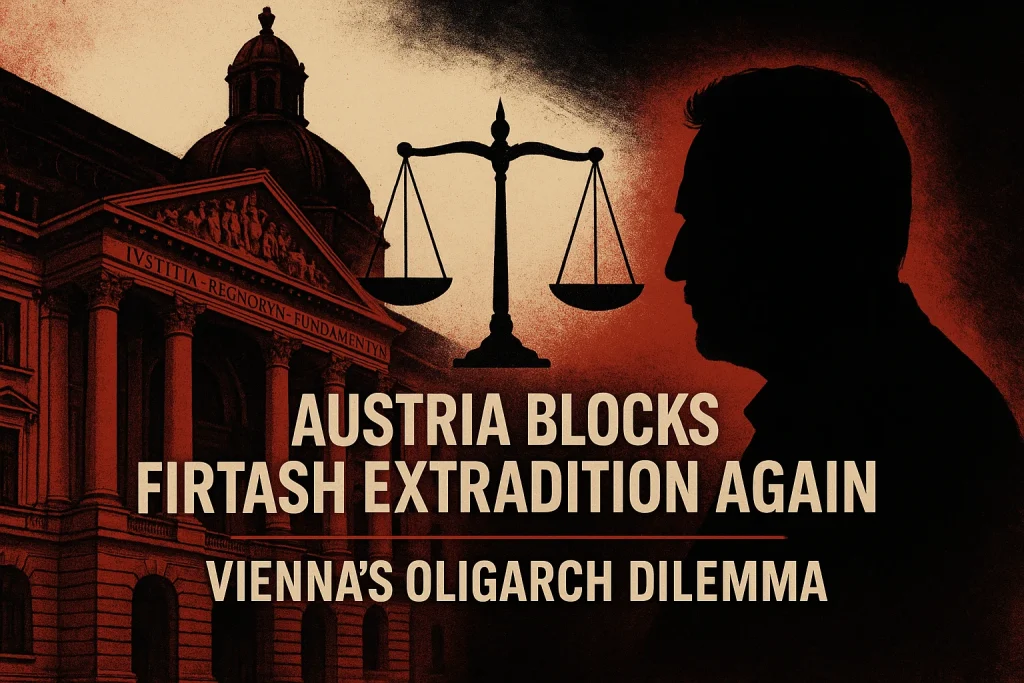
Austria’s appeals court has once more halted the handover of Ukrainian businessman Dmytro Firtash to the United States, effectively closing a case that has dragged on for more than a decade and reigniting questions about Vienna’s approach to powerful post-Soviet oligarchs.
1. The Firtash Case at a Glance
On 9 December 2025, the Vienna Higher Regional Court dismissed the public prosecutor’s appeal and upheld a 2024 decision: Firtash will not be extradited to the U.S.
A 2013 indictment in Chicago alleges that Firtash masterminded an $18.5 million bribery scheme to secure titanium mining rights in India, in violation of the U.S. Foreign Corrupt Practices Act (FCPA). He rejects the accusations as politically driven. At the same time, U.S. and Ukrainian authorities have accused him of helping to siphon off nearly $500 million from Ukraine’s gas transit system.
Key Allegations Against Dmytro Firtash
| Allegation | Jurisdiction | Amount Involved | Legal Basis / Context |
|---|---|---|---|
| Bribery for titanium mining rights | United States (Chicago) | $18.5 million | Alleged FCPA violations |
| Embezzlement from gas transit system | Ukraine / United States | Nearly $500 million | Misappropriation of funds in gas transit |
(Sources: Reuters, US Indictment)
2. Arrest in Vienna and Extradition Battles
Early Proceedings
Firtash was arrested in Vienna in 2014 and has been fighting extradition ever since. In 2015, an Austrian court initially refused the U.S. request, describing the case as partially political. That finding triggered concern among anti-corruption observers who feared Austria was setting a precedent for shielding influential figures. (Source: Euronews)
Shifting Legal Signals
Subsequently, higher courts – and Austria’s then justice minister – indicated that extradition would be legally feasible. However:
- New defence motions were filed,
- The proceedings were reopened in 2023, and
- Fresh judicial decisions eventually culminated in the current refusal to extradite.
A separate Spanish extradition request involving alleged money laundering was also dismissed. As a result, Firtash continues to live in what critics describe as comfortable exile in Vienna, on the banks of the Danube. (Sources: RadioFreeEurope, The Local Austria)
3. Firtash, Russian Gas, and Vienna’s Oligarch-Friendly Ecosystem
Firtash amassed his wealth as an intermediary in the Russian gas trade and was a key political backer of former Ukrainian president Viktor Yanukovych. Austria – and Vienna in particular – has long been seen as an attractive hub for post-Soviet capital, offering:
- Cooperative banks,
- High-end law firms, and
- A revolving door of former ministers and senior officials available as consultants or board members.
Within this environment, Firtash is frequently mentioned alongside other oligarchs who have made Vienna their base. (Sources: cdn.csd.bg, kremayr-scheriau.at)
4. Concluding Assessment: Political Connections and Legal Outcomes
The Spindelegger Connection
In March 2015, Firtash appointed former Austrian foreign and finance minister Michael Spindelegger to head the Firtash-funded Agency for the Modernisation of Ukraine (AMU). This move came just weeks before an Austrian court first turned down the U.S. extradition request. (Source: en.dmitryfirtash.com)
Spindelegger has long-standing ties to then-justice minister Wolfgang Brandstetter, including their shared background as university “Cartellbrüder”. At the time, Ukrainian politicians criticised the AMU as a vehicle for image rehabilitation and a tool to help Firtash avoid extradition rather than a genuine reform initiative. (Sources: parlament.gv.at, vn.at)
Intelligence Assessments and Media Reporting
According to a 2015 CIA report cited by Scam-Or Project, U.S. intelligence concluded that Firtash enjoyed unusual access to Austrian judges and senior political figures. The report explicitly links Spindelegger’s appointment at the AMU to Firtash’s campaign against extradition. (Source: wienerzocker.com)
Austrian journalist Florian Horcicka has similarly argued that bringing Spindelegger into Firtash’s orbit significantly strengthened his chances of evading a U.S. courtroom. In Horcicka’s assessment, this fits a wider pattern in which oligarchs leverage Vienna’s political and professional elites for legal protection and reputation management.
5. Implications for Austria’s Rule of Law
The latest ruling reinforces the perception of Austria as a jurisdiction where money, influence, and revolving-door politics can blunt international anti-corruption efforts. The outcome carries wider consequences:
- For Ukraine: it undermines attempts to pursue alleged large-scale economic crimes tied to its gas sector.
- For the United States: it represents a setback in enforcing the FCPA and related transnational corruption cases.
- For Austria: it deepens concerns about the credibility of the country’s rule of law when confronted with well-connected oligarchs.
6. Call for Whistleblowers and Insiders
Scam-Or Project urges insiders, advisers, public officials, and compliance professionals with knowledge of Firtash’s networks in Austria and Ukraine to come forward.
Information on:
- Financial structures and intermediaries,
- Political lobbying and advisory arrangements,
- Judicial or administrative interventions around the extradition cases,
can be reported confidentially via the Scam-Or Project whistleblower section.
Such disclosures are crucial for understanding how entrenched influence networks continue to shape outcomes in high-stakes corruption and extradition proceedings.