
How Unified C2B Payment Infrastructure Helps Online Marketplaces Manage Large Volumes of Transactions


As online marketplaces grow, handling customer payments becomes more difficult. A platform that processes thousands of transactions each day often has to use many payment providers and separate banking systems to cover all the bases. Over time, these disconnected processes create delays and make keeping track of incoming funds harder.
This is the type of environment where a unified C2B payment infrastructure can make a practical difference.
PayDo has expanded its customer-to-business payment capabilities with the introduction of new Settlement Accounts. The addition strengthens the company’s existing electronic money platform and gives businesses a more direct way to manage incoming bank payments.
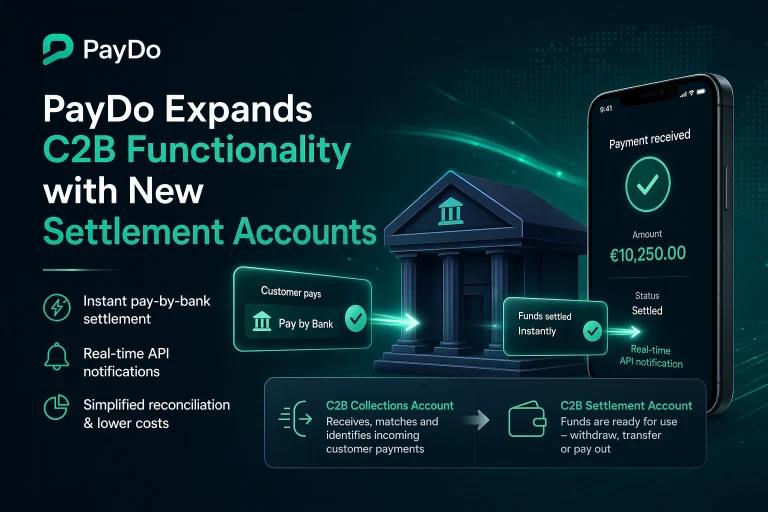
The infrastructure uses open banking connectivity to simplify the payment flow. When a customer chooses to pay by bank at checkout, the transfer is confirmed immediately and merchants receive real-time API notifications. This reduces several common problems tied to traditional bank transfers, including delayed confirmations, manual payment requests, and lengthy reconciliation work.
The structure itself is divided into two parts.
C2B Collections Accounts
PayDo introduced its C2B Open Banking Collections Accounts in late 2025. These accounts receive incoming customer payments first. The system identifies the sender and matches the payment to the correct order or customer account.
For online marketplaces, this creates a clearer process for handling incoming money. Instead of sorting payments manually or relying on several disconnected tools, businesses can track transactions through a single infrastructure.
C2B Settlement Accounts
Once payments are verified and matched, the funds move into the Settlement Account. At that point, the money becomes available for operational use.
Businesses can withdraw funds, transfer money between accounts, pay vendors, or use the balance for everyday financial operations. The distinction between collections and settlements helps companies separate incoming payment management from usable operating funds.
PayDo’s Collections Accounts already process more than 100,000 transactions each day. The addition of Settlement Accounts gives businesses a more structured way to allocate and monitor funds while reducing processing costs.
The broader aim behind the system is to reduce the operational strain created by fragmented payment setups. According to Serhii Zakharov, many businesses struggle with financial systems that do not work well together across the same organisation. The company’s approach focuses on bringing payment operations into a single environment instead of spreading them across multiple providers, all for the purpose of creating a truly all-in-one unified infrastructure.
About PayDo
PayDo is an Electronic Money Institution licensed in Malta through the MFSA, in Canada through FINTRAC, and in the United Kingdom through the FCA. The company provides businesses with tools for managing financial operations in one place, including multicurrency IBANs, merchant accounts, Visa and Mastercard payment services, virtual and physical cards, and international transfers across more than 170 countries and 50 currencies.