

Wise’s “Clean” Reputation Under Pressure: MCC 7995 Gambling Payments, Hidden Merchants, and Transaction Transparency Questions

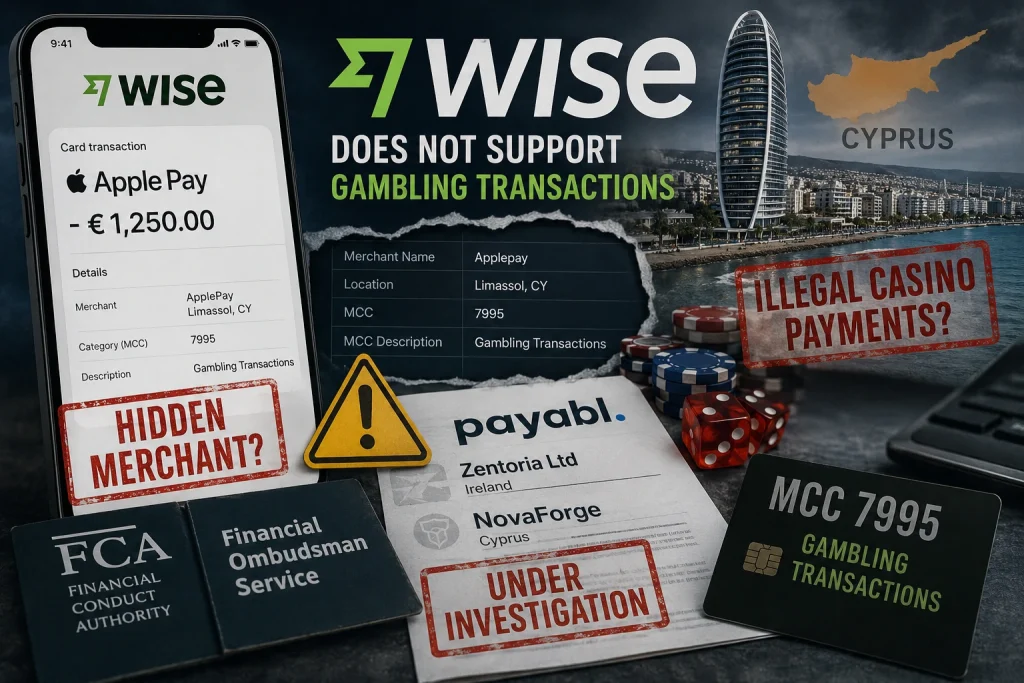
A Wise customer has accused the fintech company of masking gambling-related card transactions by displaying Apple Pay or incomplete merchant descriptors instead of the actual merchant identity, despite the transactions allegedly being categorized under MCC 7995 — the standard card-network code for gambling activity.
The customer has already escalated the dispute to both the FCA and the Financial Ombudsman Service. Scam-Or Project reviewed a substantial amount of supporting material and identified a significant contradiction that now deserves closer scrutiny: if Wise publicly claims it does not support gambling transactions, why were gambling-coded payments processed at all? And if those payments were processed, what merchant-level information was available internally within Wise?
Key Findings
- The customer alleges that disputed Wise card payments were internally tagged with MCC 7995 (Gambling Transactions), while the customer-facing transaction view failed to clearly identify the actual merchant.
- In support communications reviewed by Scam-Or Project, Wise support allegedly stated that Wise does not support gambling transactions.
- The same material appears to reference internal-style transaction details containing Applepay, Limassol, CY, and MCC 7995, raising questions about what Wise internally knew versus what was shown to the customer.
- The customer claims Wise relied on simplified transaction descriptors such as Apple Pay / Applepay while the actual merchant identity remained obscured during the dispute process.
- Wise’s public policy documents appear more nuanced than an outright prohibition, including restrictions regarding gambling-related transfers and statements that customers cannot receive funds to their Wise card from gambling or betting institutions.
- Scam-Or Project also received additional material still under review, including documents allegedly linking the gambling-related payment chain to Cyprus-based processing infrastructure.
Wise And Gambling Transactions: Why Were MCC 7995 Payments Processed?
A growing dispute between Wise and one of its customers is raising uncomfortable compliance questions about how fintech companies handle gambling-related payments behind the scenes.
According to the player’s documents reviewed by Scam-Or Project, the disputed transactions involved deposits made through a Wise card to online casinos allegedly operating illegally within the EU and the UK. The materials indicate that these deposits were processed through Payabl, which is regulated as an EMI in both the UK and Cyprus.
The reported payment recipients included, among others:
| Entity | Jurisdiction | Alleged Role |
|---|---|---|
| Zentoria Ltd | Ireland | Payment agent for casino operations |
| NovaForge | Cyprus | Payment agent linked to offshore casino activity |
| Payabl | UK / Cyprus | Payment infrastructure and acquiring services |
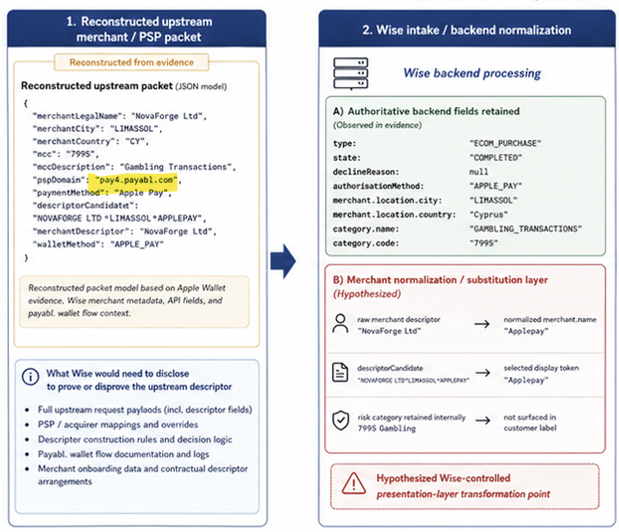
The reviewed documentation suggests that the customer repeatedly challenged Wise regarding several card transactions allegedly categorized under MCC 7995 — the industry classification for gambling transactions — while the customer-facing interface failed to clearly present them as gambling-related payments.
Instead, the transactions allegedly appeared with vague or incomplete descriptors such as:
- Apple Pay
- Applepay
- Applepay / Limassol
- Limassol, CY
rather than displaying the underlying merchant identity.
This detail became particularly important because support communications reviewed by Scam-Or Project allegedly show Wise informing the customer that the company “does not support gambling transactions.”
If the disputed transactions indeed carried MCC 7995 while Wise simultaneously maintained that it does not support gambling activity, then a central compliance question naturally emerges: how were those payments authorized and processed in the first place?
Wise’s Public Gambling Position Appears More Nuanced
Wise’s publicly available documentation appears more complex than a simple prohibition on gambling transactions.
According to the company’s published policies:
- gambling-related transfers involving certain jurisdictions are restricted;
- some unsupported-business limitations do not necessarily apply to lawful transactions conducted via the Wise Multi-Currency Card;
- customers cannot receive money to their Wise card from gambling or betting institutions.
This wording leaves room for interpretation regarding what Wise technically permits, restricts, or monitors internally.
Allegations Of Transaction Data Obfuscation
The customer’s allegations extend beyond a standard payment dispute.
According to the materials reviewed by Scam-Or Project, the customer claims Wise may have obscured or simplified merchant-level information visible to the end user, despite allegedly having access internally to more detailed transaction metadata.
The allegation is not that backend information failed to exist. Instead, the claim is that Wise allegedly possessed deeper merchant-level details — including structured merchant identifiers and gambling classifications — while the customer-facing interface remained vague or incomplete.
The reviewed material allegedly contains internal-style merchant references including:
- Applepay
- Limassol, CY
- MCC 7995
- Gambling Transactions
while the actual merchant identity allegedly remained hidden throughout parts of the support process.
Why The Case Matters
This is where the situation becomes significantly more sensitive from a compliance perspective.
Wise publicly positions itself as a compliant, low-risk financial institution that distances itself from unlicensed or illegal gambling activity. If gambling-related transactions connected to Cyprus-linked processing environments were nevertheless processed through Wise infrastructure, then the appearance of front-facing labels such as Apple Pay instead of the underlying merchant may raise legitimate questions.
In that context, the use of Apple Pay descriptors while the actual merchant allegedly operated behind a processor chain connected to Limassol no longer appears merely cosmetic. It potentially becomes operationally relevant from both a reputational and compliance standpoint.
Whether this was:
- legitimate wallet-level transaction simplification,
- poor customer-support handling,
- incomplete merchant presentation,
- or something more serious,
remains unresolved.
Wise And Illegal Casino Payment Activity?
The customer’s core argument follows a straightforward logic.
If Wise processed gambling-coded payments linked to allegedly illegal casino operations while publicly distancing itself from gambling-related activity, then limiting the visibility of the real merchant through Apple Pay descriptors or simplified transaction labels could theoretically serve a practical purpose.
The materials reviewed by Scam-Or Project point to several potentially conflicting elements:
- Wise allegedly stated it does not support gambling transactions;
- the disputed transactions allegedly carried MCC 7995;
- internal-style merchant information allegedly referenced Applepay / Limassol / Gambling Transactions;
- and the customer claims he ultimately had to reconstruct the merchant trail independently.
The customer has already escalated the matter to both the FCA and the Financial Ombudsman Service. Scam-Or Project has additionally received further supporting material that remains under examination.
At this stage, the case should be viewed as an early compliance warning signal rather than a final conclusion.
However, if future evidence confirms that Wise processed illegal gambling-related transactions while publicly presenting itself as a company that does not support gambling activity — and if customer-facing transaction data was allegedly structured in a way that concealed the actual merchant — the issue could evolve into a significant compliance and reputational problem for the fintech company.
Scam-Or Project will continue reviewing the available evidence and publish further findings as additional material becomes available.
Share Information
If you are a player, former employee, payments insider, or compliance professional with information regarding gambling-related transactions processed through Wise, Payabl, or related merchant/payment-agent structures, you can confidentially contact Scam-Or Project through the Scam-Or Project Complaints section.